

The expanded alliance between Siemens and NVIDIA marks a pivotal step in embedding artificial intelligence across industrial workflows. Announced at CES 2026, this partnership targets the full industrial value chain, from product design to supply chain management. For executives navigating digital transformation, it promises tools to shorten cycles, boost efficiency, and build resilient operations.
This collaboration leverages NVIDIA’s accelerated computing prowess alongside Siemens’ industrial software and hardware expertise. Leaders in manufacturing and engineering stand to gain from AI-driven simulations and adaptive production systems. As industries face rising demands for speed and sustainability, such integrations offer a blueprint for scaling AI in physical environments.
Siemens and NVIDIA aim to infuse AI into every phase of product development and production. Their joint efforts focus on creating AI-accelerated solutions that enable rapid innovation and ongoing optimization. This approach supports resilient, sustainable manufacturing by bridging digital models with real-world execution.
Key initiatives include GPU acceleration across Siemens’ simulation portfolio. The companies plan to incorporate NVIDIA’s CUDA-X libraries and AI physics models, allowing larger, more precise simulations at higher speeds. Customers can expect generative simulation capabilities using tools like NVIDIA PhysicsNeMo, fostering autonomous digital twins for real-time design and optimization.
The partnership’s flagship project launches in 2026 at Siemens’ Electronics Factory in Erlangen, Germany. This site will serve as the world’s first fully AI-driven, adaptive manufacturing blueprint. Early adopters such as Foxconn, HD Hyundai, KION Group, and PepsiCo are already testing these systems.
These elements address longstanding bottlenecks in traditional manufacturing. For instance, simulation times that once took weeks could shrink dramatically, enabling iterative designs without physical prototypes. Link suggestion: NVIDIA Omniverse documentation for deeper technical specs.
Transitioning from design to deployment requires robust infrastructure. The partners emphasize scalability across verticals, ensuring broad applicability.
Semiconductor design sits at the heart of accelerated computing, and Siemens NVIDIA are targeting 2-10x speedups in critical workflows. Building on NVIDIA’s established use of Siemens tools, the collaboration integrates CUDA-X libraries, PhysicsNeMo, and GPU acceleration into electronic design automation (EDA) portfolios. Focus areas include verification, layout, and process optimization.
AI-assisted features will enhance engineer productivity. Layout guidance, debug support, and circuit optimization ensure compliance with manufacturability standards. This evolution supports AI-native engines for design, verification, and digital twins, ultimately shortening cycles and improving yields.
In practice, these tools close the gap between conceptual ideas and reliable production. Engineers gain autonomous optimization, reducing manual iterations. For chipmakers racing AI demands, this means faster time-to-market amid complex physics challenges.
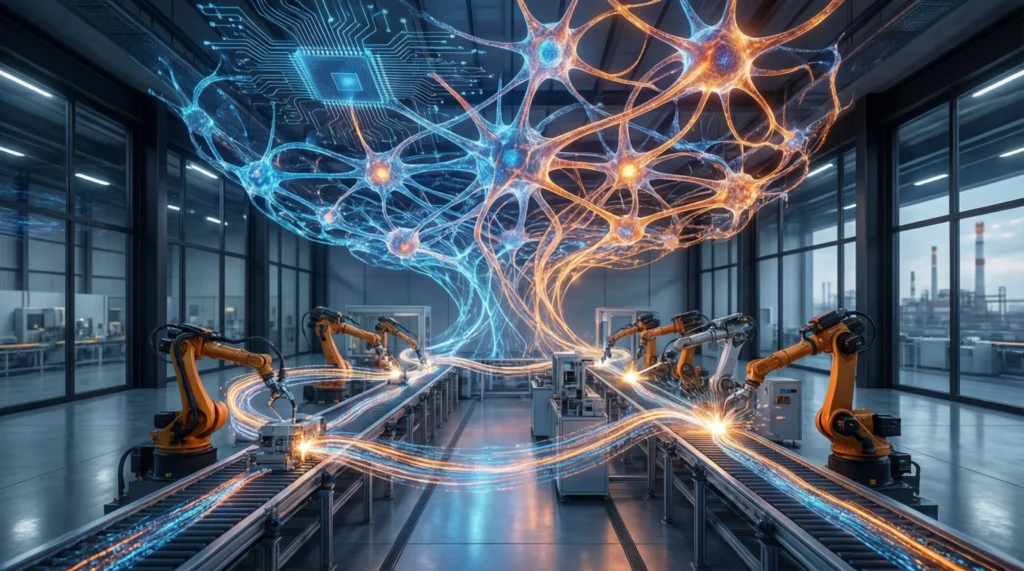
This segment of the partnership underscores a feedback loop: AI factories rely on advanced chips, which in turn benefit from EDA advancements. Link suggestion: Siemens EDA solutions overview for case studies.
Designing factories for AI workloads demands balance in power, cooling, and automation. Siemens and NVIDIA’s repeatable blueprint addresses these, optimizing from planning to operations. It merges NVIDIA’s AI platform roadmap and Omniverse simulations with Siemens’ electrification, grid integration, and automation strengths.
The result? Accelerated deployment of high-density computing with improved energy efficiency and resilience. Factories become foundational for industrial AI portfolios, supporting dense GPU clusters without compromising sustainability. This positions industries for global scalability.
Consider the implications for data centers and production sites. Traditional setups struggle with AI’s power hunger; this blueprint integrates smart infrastructure proactively. Executives can deploy modular designs that evolve with tech roadmaps.
Key optimization pillars include:
By testing on their own facilities first, the partners validate real-world viability. This “build once, scale everywhere” model de-risks adoption for customers.
Beyond joint products, Siemens and NVIDIA commit to accelerating each other’s operations. NVIDIA evaluates Siemens’ offerings to streamline its workflows, while Siemens integrates NVIDIA tech into its systems and customer portfolios. This shared innovation creates proof points of value.
For NVIDIA, Siemens tools optimize internal processes like chip design. Siemens gains AI enhancements for its hardware and software stacks. Customers benefit from battle-tested implementations, reducing adoption hurdles.
This reciprocal approach fosters ecosystem-wide progress. It demonstrates how AI scales from pilot to enterprise, with measurable gains in speed and reliability.
Link suggestion: CES 2026 Siemens NVIDIA announcement for official details.
This partnership redefines industrial AI as an operating system for the physical world. Roland Busch, Siemens CEO, highlights its role in empowering faster product development via comprehensive digital twins. Jensen Huang of NVIDIA envisions generative AI transforming passive simulations into active intelligence.
Market context amplifies its timeliness. Global manufacturing seeks AI to counter supply chain volatility and sustainability pressures. Analysts project industrial AI markets growing at 45% CAGR through 2030, per recent McKinsey reports, driven by simulation and automation.
For executives, the strategic pivot involves auditing current workflows for AI readiness. Identify simulation bottlenecks and pilot GPU accelerations. Long-term, build AI factories to anchor competitive edges.
Comparative analysis shows early movers like Foxconn gaining 20-30% efficiency lifts in pilots. Laggards risk obsolescence as adaptive systems become standard.
In sum, Siemens NVIDIA’s framework delivers actionable paths to AI-integrated operations. Leaders who integrate these tools position their firms for enduring leadership.
About NVIDIA
NVIDIA (NASDAQ: NVDA) is the world leader in AI and accelerated computing.
Siemens AG (Berlin and Munich) is a leading technology company focused on industry, infrastructure, mobility, and healthcare. The company’s purpose is to create technology to transform the everyday, for everyone. By combining the real and the digital worlds, Siemens empowers customers to accelerate their digital and sustainability transformations, making factories more efficient, cities more livable, and transportation more sustainable. A leader in industrial AI, Siemens leverages its deep domain know-how to apply AI – including generative AI – to real-world applications, making AI accessible and impactful for customers across diverse industries. Siemens also owns a majority stake in the publicly listed company Siemens Healthineers, a leading global medical technology provider pioneering breakthroughs in healthcare. For everyone. Everywhere. Sustainably.