

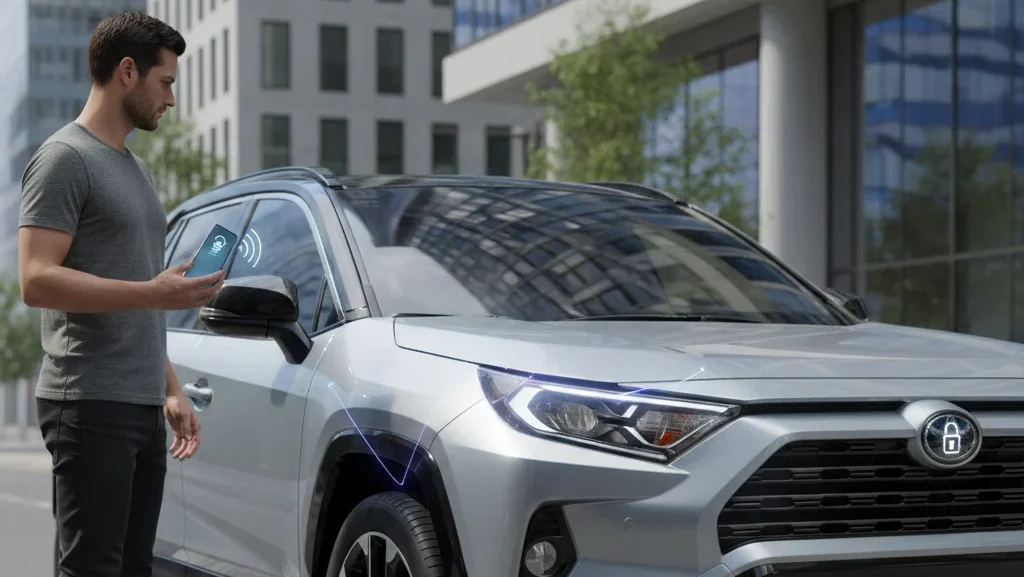
Samsung Electronics announced a significant expansion of its mobile ecosystem today, revealing that Samsung Wallet will begin supporting Digital Key compatibility for select Toyota vehicles starting in January 2026. This update marks another step in Samsung’s ongoing effort to simplify users’ daily routines by merging advanced connectivity features with multilayered security. With this new capability, owners of compatible Samsung Galaxy smartphones will be able to unlock, lock, and start supported Toyota vehicles without needing a traditional key fob.
This collaboration begins with one of Toyota’s most popular models — the 2026 Toyota RAV4 — and is expected to broaden over time. Samsung emphasizes that the move reflects its commitment to combining mobility, convenience, and high-grade digital security into a single, user-friendly solution.
A Step Toward a More Seamless Driving Experience
In the announcement, Woncheol Chai, EVP and Head of the Digital Wallet Team for Samsung’s Mobile eXperience (MX) Business, highlighted the company’s broader vision for Samsung Wallet. According to Chai, Samsung Wallet is meant to reduce day-to-day friction by bringing together essential digital tools in one reliably secure place. He stated, “Samsung Wallet is designed to remove friction from daily life through the combination of seamless convenience and uncompromising security. By bringing Digital Key support to Toyota vehicles, starting with the 2026 Toyota RAV4, we’re extending those benefits to more people, so that Galaxy users can get on the road faster, safer and more easily.”
Samsung Wallet already acts as a centralized home for users’ payment cards, mobile IDs, passes, and various other digital credentials. With the addition of vehicle Digital Keys, Samsung further deepens the integration of its software into the larger Galaxy ecosystem. The company’s goal is to let users carry fewer physical items while still maintaining tight control over sensitive information.
How Digital Key Integration Works
Once a compatible Toyota vehicle is registered with Samsung Wallet, drivers can use their Galaxy smartphone to interact directly with the car. Instead of reaching for a physical key or even tapping a button on a fob, the driver can simply walk up to the car; the smartphone will handle authentication and unlock the doors automatically.
This hands-free functionality is made possible through Ultra-Wideband (UWB) technology. UWB is a high-precision, short-range wireless communication protocol that can accurately measure distance between devices. Samsung and other industry players, through the Car Connectivity Consortium (CCC), have helped standardize UWB for secure digital car keys. Thanks to this standardization, UWB offers significantly stronger resistance to common threats such as relay attacks, which have become a point of concern in the automotive industry as keyless entry systems grow more common.
In addition to UWB, Near Field Communication (NFC) technology also plays a central role. NFC allows users to tap their phones near designated areas of the vehicle to perform functions like unlocking or starting the engine. While UWB supports a completely hands-free experience, NFC provides a reliable backup method that works even if the driver prefers or needs a more manual interaction.
Sharing Digital Keys Securely
Another notable advantage of Samsung’s implementation is the ability to share Digital Keys with trusted contacts. Samsung Wallet allows Galaxy users to grant access to another driver — ideal for families with multiple drivers, lending a vehicle temporarily, or managing a shared household car.
Shared keys are managed entirely within Samsung Wallet, giving the primary owner full control. Access can be modified, time-limited, or revoked altogether, all from the app’s interface. Samsung designed this system to be flexible but also to maintain the highest security standards, ensuring that only approved individuals can use the shared digital key.
Knox Security: The Foundation of Digital Key Protection
Like all sensitive information stored on Samsung devices, Digital Keys are protected by Samsung Knox, the company’s defense-grade security platform. Knox is built directly into the hardware and software layers of Samsung’s smartphones, offering a multi-tiered security structure. This protects data against tampering, unauthorized access, malware threats, and other emerging digital risks.
Samsung also notes that Digital Keys meet rigorous EAL6+ certification standards. This certification is one of the highest levels of security evaluation in the mobile device industry, typically reserved for systems managing extremely sensitive information. Achieving EAL6+ certification underscores Samsung’s commitment to providing protection strong enough to defend against both software and hardware-based attacks.
Protection in Case of Loss or Theft
Samsung understands that losing a smartphone can be stressful, especially when it contains digital access credentials. To address this, the Digital Key system is integrated with the Samsung Find service. If a device with a stored Digital Key is lost or stolen, users can remotely lock the device or completely delete the Digital Key, blocking anyone else from using it.
Samsung Wallet also includes biometric authentication and PIN verification to ensure that even someone holding the unlocked phone cannot gain access to the vehicle without proper identity confirmation.
These layers of security — remote lockout, Knox protection, biometric verification, and EAL6+ certification — combine to create an environment where users can confidently rely on their smartphones for vehicle access without worrying about unauthorized use.
Expanding the Galaxy Ecosystem Into Mobility
Samsung’s expansion of Digital Key capabilities reinforces its long-term vision of a fully connected ecosystem where Galaxy devices become central tools in users’ everyday lives. The company has already integrated Samsung Wallet into smart home devices, payment systems, travel documentation, and secure identification frameworks.
Adding automotive functionality is a logical next step. The car is one of the most frequently accessed personal devices people interact with, and transforming the smartphone into the core access point aligns with broader trends in consumer technology. Automakers worldwide are exploring digital-first interfaces, advanced driver assistance systems, enhanced connectivity, and app-based controls — all areas where Samsung’s software and hardware solutions can offer complementary value.
Although the initial rollout focuses on select Toyota models, the partnership signals a potential expansion in the future. As more vehicles adopt UWB and NFC standards and as consumer comfort with digital keys grows, the technology is expected to move from a high-end convenience to a mainstream expectation.
Source Link:https://news.samsung.com/