

U.S. Energy Leadership Visits General Atomics to Advance Fusion Energy and National Security Research
A high-level delegation from the U.S. Department of Energy (DOE), including U.S. Secretary of Energy Chris Wright, Under Secretary for Science Darío Gil, and Conner Prochaska, recently visited General Atomics in San Diego, California. The visit spotlighted ongoing advances in fusion energy research and engineering, as well as the organization’s critical contributions to U.S. national security programs.
The delegation toured several key facilities, including the DIII-D National Fusion Facility and specialized inertial confinement fusion (ICF) laboratories. The visit emphasized the United States’ growing commitment to accelerating fusion energy development as both a clean energy solution and a strategic scientific priority.
Strengthening U.S. Leadership in Fusion Energy
At the center of the visit was the DIII-D National Fusion Facility, operated by General Atomics on behalf of the U.S. Department of Energy. DIII-D is recognized as the largest magnetic fusion research facility in the United States and serves as a cornerstone of the national fusion research ecosystem.
During the tour, Secretary Wright, Under Secretary Gil, and Director Prochaska engaged directly with scientists and engineers working at the facility. These researchers are focused on addressing some of the most pressing scientific and engineering challenges that must be solved before fusion energy can become commercially viable. Their work includes plasma confinement optimization, advanced diagnostics, and experimental validation of next-generation fusion reactor designs.
The facility also functions as a collaborative hub, bringing together experts from national laboratories, universities, and private industry. This multi-institutional model is seen as essential for accelerating progress toward practical fusion power plants.
Scientific Breakthroughs and Technology Development at DIII-D
DIII-D plays a critical role in advancing magnetic confinement fusion research, particularly in the tokamak design approach, which uses powerful magnetic fields to contain extremely hot plasma. The facility supports experiments that simulate conditions similar to those needed for sustained fusion reactions.
Researchers at DIII-D are actively working on:
- Improving plasma stability and confinement times
- Reducing energy losses in fusion reactions
- Developing predictive models using artificial intelligence and machine learning
- Testing digital twin technologies to simulate reactor performance
- Enhancing material durability under extreme heat and neutron exposure
These efforts are designed to close key gaps between experimental fusion devices and future commercial reactors capable of producing net energy gain.
According to senior leadership at General Atomics, continuous upgrades to DIII-D have kept the facility at the forefront of global fusion research. The integration of advanced computational tools and experimental systems has enabled increasingly sophisticated studies of plasma behavior.
Leadership Perspectives on Fusion Innovation
During the visit, senior officials emphasized the strategic importance of fusion energy for both energy security and scientific leadership.
Chris Wright described fusion as a transformative opportunity, noting that it represents the same process that powers stars and could one day provide abundant, carbon-free electricity on Earth. He highlighted how facilities like DIII-D are turning decades of theoretical research into practical progress toward commercial energy systems.
Under Secretary Darío Gil emphasized the importance of bridging fundamental science and engineering development. He noted that sustained investment in experimental infrastructure is essential for maintaining U.S. leadership in advanced energy technologies.
Anantha Krishnan, representing General Atomics leadership, expressed appreciation for continued DOE support. He emphasized that achieving commercial fusion energy remains one of the most complex scientific and engineering challenges of the modern era, requiring long-term collaboration between government, industry, and academia.
Inertial Confinement Fusion and National Security Applications
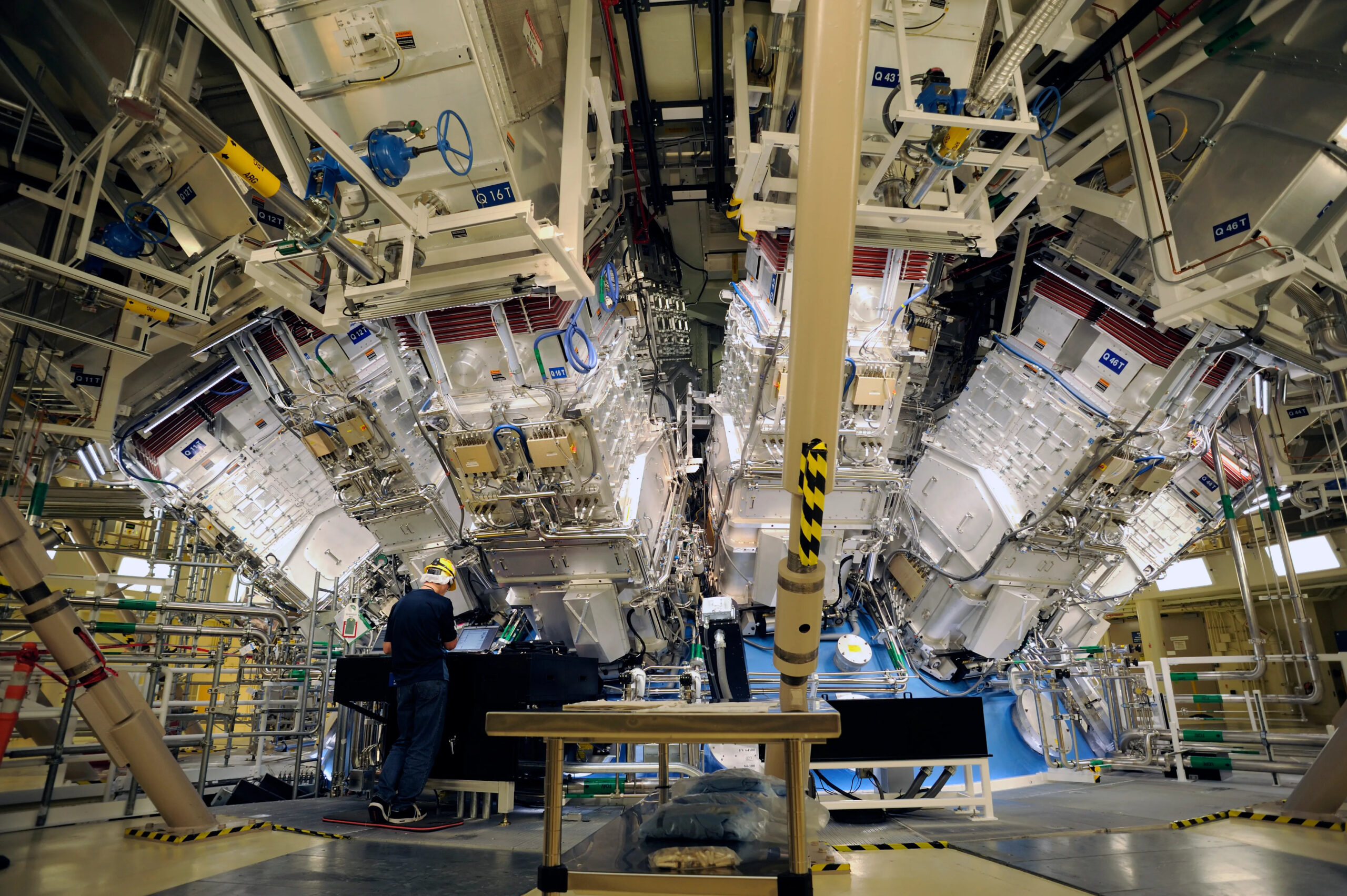
Beyond magnetic fusion research, the delegation also toured General Atomics’ inertial confinement fusion (ICF) target fabrication and manufacturing facilities. These capabilities support critical national security missions, particularly through the National Nuclear Security Administration (NNSA) Stockpile Stewardship Program.
ICF research involves compressing small fuel targets using powerful lasers or other energy sources to initiate fusion reactions. This research is essential for understanding high-energy-density physics and maintaining the reliability of the U.S. nuclear stockpile without underground testing.
General Atomics provides specialized expertise in:
- Precision target fabrication
- Diagnostic instrumentation for fusion experiments
- Metrology and measurement technologies
- Engineering support for national laboratory experiments
Mike Farrell highlighted the extreme precision required in inertial fusion research, noting that even microscopic variations in target design can significantly affect experimental outcomes. He emphasized the importance of close collaboration with the National Nuclear Security Administration and national laboratories across the country.
Public-Private Collaboration Driving Fusion Progress
A key theme of the visit was the importance of public-private partnerships in advancing fusion science. The DIII-D facility, operated by General Atomics for the DOE, exemplifies this model by combining federal funding, academic research, and industrial innovation.
Wayne Solomon described DIII-D as a collaborative platform where scientists and engineers from different sectors work together to solve complex challenges. He emphasized that such collaboration is essential for accelerating the transition from experimental fusion devices to commercial reactors.
The facility also plays an important role in workforce development. By training engineers, physicists, and technicians in advanced fusion technologies, DIII-D helps build the talent pipeline needed for a future fusion industry. Additionally, its work in machine learning, digital twin modeling, and advanced simulation is contributing to broader innovation in energy systems design.
Fusion Energy: A Long-Term Vision for Clean Power
Fusion energy is often described as the “holy grail” of clean energy because it replicates the same process that powers the sun and stars. Unlike conventional nuclear fission, which splits atoms, fusion combines light atomic nuclei to release vast amounts of energy with minimal long-lived radioactive waste.
If successfully commercialized, fusion could provide:
- Near-limitless clean energy
- Zero carbon emissions during operation
- High energy density compared to fossil fuels
- Reduced long-term nuclear waste challenges
However, significant scientific and engineering hurdles remain. These include achieving sustained plasma confinement, managing extreme temperatures, and developing materials capable of withstanding intense neutron bombardment over long operational periods.