

Driving Physical AI Is Driving the Next Robotaxi Revolution
Driving The robotaxi industry is rapidly emerging as one of the first major commercial applications of physical AI, bringing autonomous vehicles from research labs and pilot programs onto real-world streets. The global robotaxi market is projected to reach approximately $400 billion by 2035, with millions of commercial autonomous vehicles expected to be operating worldwide.
But putting a driverless vehicle on the road is only the beginning. The bigger challenge is scaling autonomous driving technology across thousands of vehicles while maintaining consistent, safe, and reliable performance.
Achieving that scale requires enormous computing power throughout the entire development lifecycle. Autonomous driving systems must process massive amounts of data, train increasingly sophisticated AI models, simulate millions of driving scenarios, validate safety, and perform real-time AI inference inside the vehicle.
NVIDIA is positioning its technology platform to address these requirements with an ecosystem spanning AI training, simulation, safety validation, and in-vehicle computing. Its software libraries, development kits, workflows, and AI models are designed to work alongside the technology stacks developed by autonomous vehicle companies and automakers.
Today, major robotaxi programs across North America, Europe, Asia, and the Middle East are adopting NVIDIA technologies at different stages of development — from training and simulation to the computers that power autonomous vehicles on the road.
What Is a Robotaxi Technology Stack?
A robotaxi technology stack is the collection of hardware and software required to develop, test, validate, and operate an autonomous vehicle.
It starts with collecting and processing driving data, followed by AI model training and simulation. Developers then need to validate the vehicle against countless scenarios before deploying the technology in real-world conditions.
NVIDIA brings these capabilities together through a three-computer architecture: a system for AI model training, a platform for simulation and validation, and an in-vehicle computer responsible for running AI workloads in real time.
1. Training Autonomous Driving AI With NVIDIA DGX
Robotaxi intelligence improves as autonomous driving companies collect more data and use it to train increasingly capable AI models.
NVIDIA DGX systems provide the computing infrastructure needed to train these models at scale. Developers can also use NVIDIA’s Alpamayo portfolio of open reasoning vision-language-action models, physical AI datasets, simulation frameworks, and training tools as building blocks for their own autonomous driving systems.
Alpamayo models are designed to help address difficult and unpredictable driving situations. Rather than simply reacting to an input, reasoning-based models can break complex scenarios into smaller steps, evaluate possible outcomes, and select an appropriate trajectory.
NVIDIA also provides reinforcement-learning blueprints, post-training tools, and model-distillation techniques that can help developers adapt AI models to specific vehicles and operational requirements.
In one challenging autonomous-driving evaluation, adding meta-action and chain-of-thought reasoning data improved trajectory prediction accuracy. The minimum average displacement error was reduced by 43%, from 2.08 to 1.18, demonstrating the potential of reasoning-based AI for complex driving scenarios.
2. Simulating Millions of Driving Scenarios
Real-world testing alone cannot expose autonomous vehicles to every possible situation. Some of the most important scenarios are rare — such as unusual traffic behavior, unexpected road conditions, extreme weather, or complex interactions between vehicles and pedestrians.
Simulation provides a way to generate and test these situations at a much larger scale.
NVIDIA Omniverse NuRec can reconstruct real-world driving environments from sensor data. NVIDIA Cosmos world foundation models can then generate physically based variations of those environments, allowing developers to create a wide range of scenarios involving different traffic patterns, weather conditions, lighting, road layouts, and sensor inputs.
This approach can transform a relatively small collection of real-world edge cases into thousands or even millions of synthetic variations.
NVIDIA Omniverse and Cosmos run on NVIDIA RTX PRO Servers to support closed-loop simulation and validation. The NVIDIA AlpaSim simulation framework further extends this environment for training and evaluating reasoning-based autonomous-driving models.
By identifying weaknesses in simulation before vehicles reach public roads, developers can potentially reduce development time while increasing the breadth of safety testing.
3. Powering Robotaxis Inside the Vehicle
Once an autonomous driving model has been trained and validated, it must operate reliably inside the vehicle.
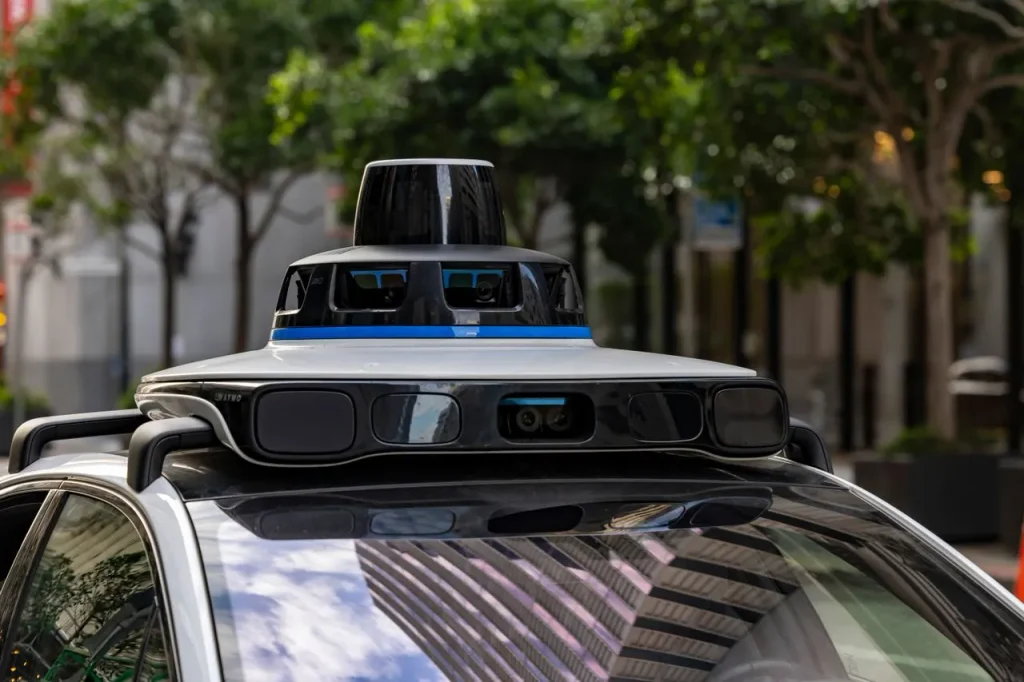
NVIDIA DRIVE Hyperion is a modular in-vehicle computing and sensor reference architecture designed for Level 4-ready robotaxis. DRIVE Hyperion 10 combines two NVIDIA DRIVE AGX Thor systems-on-a-chip with an extensive sensor configuration that includes 14 high-definition cameras, nine radars, three lidars, and 12 ultrasonic sensors.
The architecture is designed to provide 360-degree perception while maintaining redundancy. If a sensor or computing component fails, the system is designed to support fail-operational driving.
The dual DRIVE AGX Thor configuration is built to handle demanding AI workloads, including perception, reasoning, path planning, and driving actions. This makes the in-vehicle computer a critical part of the physical AI system.
Safety is another major component. NVIDIA Halos provides a safety foundation that includes Halos OS and a broader validation and certification framework. It covers areas such as independent inspection, system validation, large-scale simulation, and continuous testing from cloud infrastructure to the vehicle itself.
Robotaxi Leaders Are Scaling With NVIDIA
NVIDIA’s robotaxi ecosystem extends across major autonomous driving markets around the world. Mobility providers, automakers, and autonomous vehicle developers are adopting various parts of NVIDIA’s technology stack to develop and scale their services.
Uber, for example, is working with NVIDIA to expand its robotaxi ecosystem and plans to deploy NVIDIA DRIVE Hyperion-based vehicles across multiple cities. The companies are also developing a robotaxi AI data factory using NVIDIA Cosmos to organize fleet data and identify rare driving scenarios.
Other mobility companies, including May Mobility, Lyft, and Bolt, are also using or planning to use NVIDIA technologies as part of their autonomous vehicle strategies.
In Southeast Asia, WeRide is working with Grab to bring its DRIVE Hyperion- and DRIVE AGX Thor-based autonomous vehicles to key markets. Waymo is also partnering with NVIDIA on autonomous computing.
Behind these commercial services, autonomous vehicle developers are building the AI systems that power the vehicles.
Wayve, Nissan, and Uber are developing a global robotaxi program combining Nissan’s vehicle engineering with Wayve’s embodied AI and NVIDIA DRIVE Hyperion.
Autobrains is developing robotaxi programs with Uber in Munich and VinFast in Southeast Asia. Zoox uses NVIDIA DRIVE technology for in-vehicle computing as well as cloud-based training and simulation, while Momenta and Pony.ai are developing autonomous driving systems using NVIDIA DRIVE platforms.
Other companies, including Waabi, TIER IV, Isuzu, Lenovo, SWM, and DeepRoute.ai, are also developing autonomous vehicles and robotaxi systems around NVIDIA technology.
Bringing Autonomous Vehicles Into Production
As robotaxi technology matures, automakers are increasingly integrating autonomous driving capabilities into production vehicle programs.
Mercedes-Benz and NVIDIA are working with Uber on a robotaxi ecosystem based on the new S-Class and NVIDIA DRIVE Hyperion architecture. Stellantis, Wayve, and Uber are also collaborating on Level 4 driverless mobility services.
Lucid, Nuro, and Uber are developing a global robotaxi service using NVIDIA DRIVE AGX Thor, while Hyundai Motor and Kia are expanding their work with NVIDIA on data-driven autonomous driving systems.
Geely and its ecosystem partners are planning to develop and commercialize robotaxis using DRIVE Hyperion, while its Zeekr brand has adopted DRIVE AGX Thor for centralized vehicle computing.
Tesla, meanwhile, uses NVIDIA supercomputers to train its autonomous-driving neural networks.
The Road Ahead for Physical AI
The development of robotaxis highlights a broader transformation taking place in artificial intelligence. Physical AI is moving beyond digital environments and into the physical world, where AI systems must perceive, reason, make decisions, and act safely.
For robotaxi companies, success will depend not only on developing smarter AI models but also on building the massive computing infrastructure required to train, simulate, validate, and deploy those models at scale.
NVIDIA’s three-computer approach — combining powerful AI training systems, large-scale simulation and validation, and high-performance in-vehicle computing — is designed to connect these stages into a unified development pipeline.
As robotaxi services expand into more cities and markets, the ability to continuously improve AI while maintaining safety and reliability will become increasingly important. The companies building this infrastructure today are laying the foundation for a future in which autonomous vehicles could become a mainstream part of global transportation.
Source Link: https://blogs.nvidia.com/