

Axelspace-led consortium selected by JAXA to advance next-generation Earth observation satellite technologies for enhanced CO₂ emissions monitoring
A consortium led by Axelspace Corporation, in collaboration with Meisei Electric Co., Ltd., ANA HOLDINGS INC., and JIJ Inc., has been selected for a prestigious technology development initiative under the Space Strategy Fund of the Japan Aerospace Exploration Agency. The project falls under the theme “Technology to Enhance Capability of Next Generation Earth Observation Satellites,” highlighting Japan’s continued commitment to advancing satellite-based environmental monitoring and climate solutions.
This collaborative effort represents a significant step forward in the evolution of Earth observation technologies, particularly in the area of greenhouse gas monitoring. The selected project, titled “Source-Specific CO2 Emission and Uptake Monitoring through Satellite Constellation and Aircraft Observations,” aims to develop an innovative, integrated observation system capable of delivering highly detailed, time-sensitive, and source-specific carbon dioxide (CO2) data.
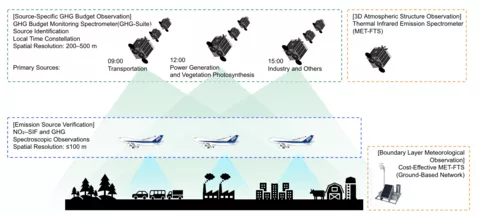
At its core, the project envisions the creation of a next-generation observation network that combines satellite constellations with aircraft and ground-based sensing systems. This integrated approach is designed to overcome the limitations of current observation methods, which often lack sufficient temporal resolution or source attribution capability. By synchronizing multiple observation platforms, the system will enable simultaneous, multi-point data collection at different times of the day—specifically in the morning, noon, and afternoon. This capability is particularly valuable for monitoring emissions in densely populated urban regions, where CO2 output can vary significantly throughout the day.
The data generated through this system will be used to analyze CO2 emissions and absorption patterns with unprecedented granularity. By identifying emissions according to source sectors—such as transportation, industrial activity, and residential energy use—as well as by time and geographic location, the project aims to provide actionable insights for policymakers, researchers, and environmental stakeholders. Such detailed and transparent information could play a crucial role in establishing international benchmarks for greenhouse gas (GHG) reduction efforts and supporting the development of globally harmonized frameworks for emissions evaluation.
One of the most critical aspects of this initiative is its focus on advancing sensor technology, particularly the development of compact and cost-effective spectrometers. Spectrometers are essential instruments for measuring atmospheric gas concentrations. They operate by detecting how different gases absorb light at specific wavelengths, allowing scientists to determine the concentration of those gases based on the degree of absorption observed.
Traditionally, high-precision spectrometers used in government-operated satellites have been large, complex, and expensive, limiting their deployment to a small number of platforms. This project seeks to address these challenges by developing a new generation of miniaturized spectrometers that maintain high performance while significantly reducing size and cost. By leveraging advanced detector technologies developed domestically in Japan, the consortium aims to produce sensors that can be widely deployed across satellites, aircraft, and ground-based systems.
The ability to use a common sensor across multiple observation platforms is a key innovation of this project. It ensures consistency in data collection and enables seamless integration of measurements from different sources. This uniformity is essential for accurately comparing and combining data, ultimately leading to more reliable and comprehensive CO2 monitoring.
As part of the development process, the consortium plans to conduct a series of validation tests using aircraft equipped with the newly developed sensors. These tests will serve as an important step in verifying the performance and accuracy of the technology under real-world conditions. Insights gained from these trials will inform further refinements before the technology is deployed in space.
Looking ahead, the project includes plans to launch a demonstration satellite equipped with the compact spectrometer. This launch is tentatively scheduled to take place between fiscal years 2030 and 2032. The primary objective of this satellite mission will be to acquire in-orbit observation data, demonstrating the feasibility and effectiveness of the new sensor technology in a space environment.
The successful deployment of this demonstration satellite will pave the way for the establishment of a full-scale satellite constellation dedicated to CO2 monitoring. When combined with aircraft and ground-based observations, this constellation will form a comprehensive, multi-layered observation network capable of delivering continuous, high-resolution data on global carbon dynamics.
Beyond its technical achievements, the project has broader implications for climate policy and international cooperation. Accurate and transparent measurement of CO2 emissions is a fundamental requirement for tracking progress toward climate goals, such as those outlined in the Paris Agreement. By providing reliable, independently verifiable data, the system developed through this initiative could help build trust among nations and support the implementation of effective emissions reduction strategies.
Furthermore, the project’s emphasis on affordability and scalability aligns with the growing need for accessible climate monitoring solutions. By reducing the cost of advanced spectrometer technology, the consortium is enabling wider adoption of high-quality observation systems, potentially benefiting countries and regions that currently lack such capabilities.
In summary, the selection of this project by JAXA’s Space Strategy Fund underscores its strategic importance and technological promise. Through the combined expertise of Axelspace Corporation and its partners, the initiative aims to transform how CO2 emissions are monitored and understood. By integrating satellite, airborne, and ground-based observations with cutting-edge sensor technology, the project is poised to make a meaningful contribution to global efforts to combat climate change and promote sustainable development.