

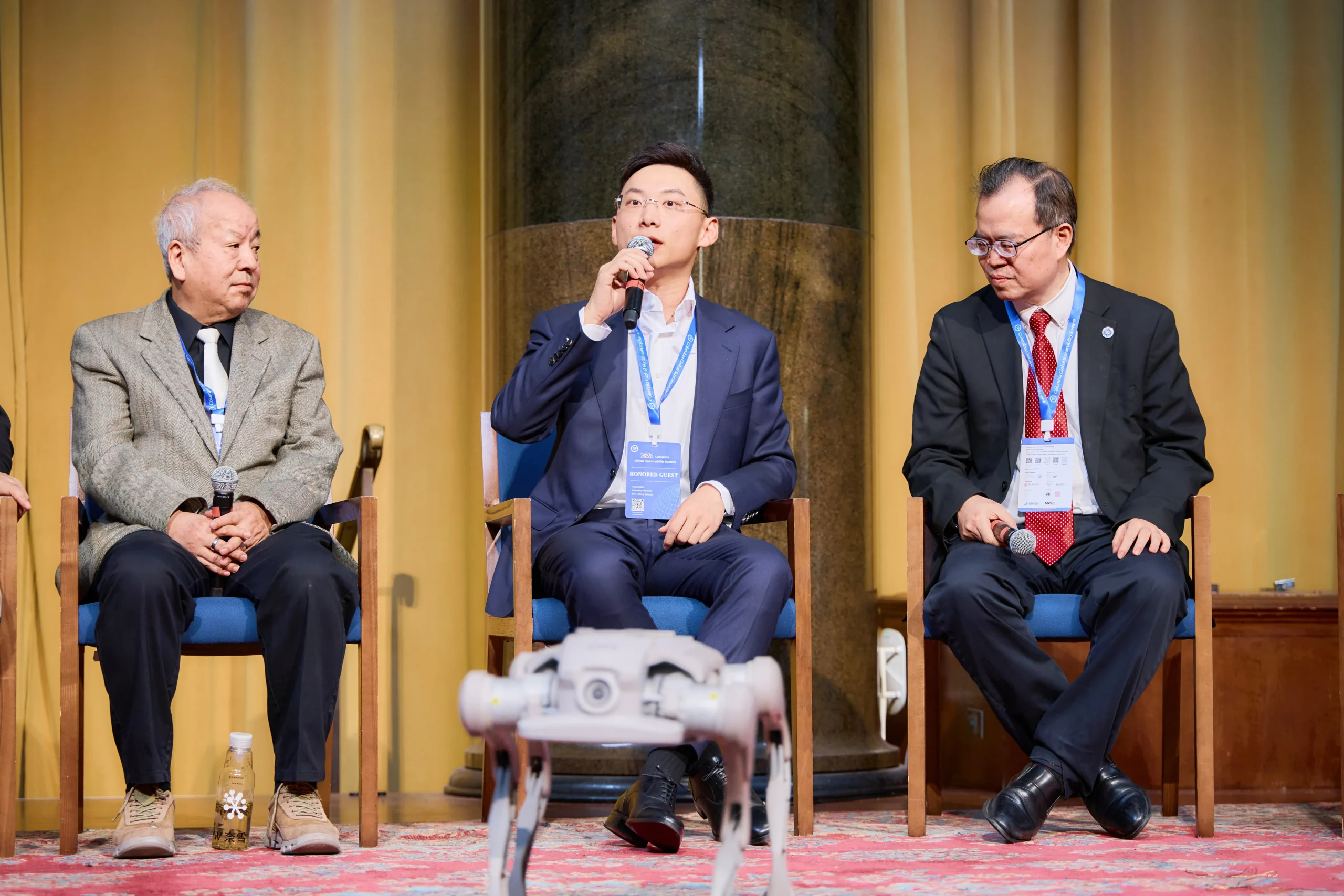
Faraday Future Leaders Showcase Embodied AI Innovations at 2026 Columbia Global Sustainability Summit
Faraday Future Intelligent Electric Inc. (NASDAQ: FFAI) (“Faraday Future”, “FF”, or the “Company”), a California-based global leader in the Embodied AI (EAI) ecosystem, recently marked a significant milestone in its journey beyond mobility by participating in the 2026 Columbia Global Sustainability Summit, held on April 5th at Columbia University in New York. The Summit, a premier international forum for dialogue on sustainability, technology, and global governance, provided a dynamic platform for Faraday Future to demonstrate its cutting-edge advancements in AI and robotics, emphasizing the transformative potential of its EAI-Robotics solutions.
Representing Faraday Future at the Summit were Jerry Wang, Global President, and Chris Chen, Co-CEO of FF AI-Robotics. Both executives engaged with global thought leaders, policymakers, academics, and industry innovators to explore how intelligent robotics and AI technologies are reshaping multiple facets of human society. Their participation underscored Faraday Future’s commitment to driving technological innovation that extends beyond mobility and directly impacts areas such as education, research, data analytics, security, and entertainment.
Jerry Wang participated in a panel discussion on the Summit’s Global Governance Track, titled “Reimagining the Architecture of the Future World Order.” During the discussion, Jerry explored the evolving role of technology in shaping governance frameworks and the broader societal implications of AI integration. Emphasizing the importance of establishing clear, ethical rules for AI, Jerry highlighted Faraday Future’s approach to responsible innovation. He outlined how EAI-Robotics could be deployed to enhance governance systems by enabling more efficient data collection, inspection, and monitoring, thereby supporting transparency, accountability, and informed decision-making in both public and private sectors.
Meanwhile, Chris Chen contributed to the Summit’s Artificial Intelligence Track, titled “Reprogramming the Future of Human Civilization.” His discussion focused on the transformative potential of AI and robotics across multiple domains, highlighting real-world applications of Faraday Future’s EAI-Robotics technology. Chris emphasized the significance of human-AI collaboration, noting that the future of civilization will depend on a careful balance between autonomous AI capabilities and human oversight. He illustrated practical applications of FF AI-Robotics, ranging from K-12 educational programs that enrich learning experiences, to scientific research initiatives that enhance experimental efficiency, and from security and inspection tasks to immersive entertainment experiences that bring robotics closer to mainstream adoption.
The Summit’s overarching theme, “Reprogramming the Future: A New Paradigm for Global Progress,” convened leading global minds from academia, industry, and policy-making bodies to explore critical topics at the intersection of technology and sustainability. Over the course of the event, participants engaged in in-depth discussions on artificial intelligence, biomedical innovation, sustainable finance, and the future of global governance. By participating in these dialogues, Faraday Future positioned itself as not just an innovator in mobility, but as a forward-looking technology ecosystem company committed to creating positive societal impact through sustainable AI and robotics solutions.
Both Jerry Wang and Chris Chen underscored the strategic importance of Faraday Future’s expansion into the broader technology ecosystem. “We were honored to participate in this year’s Columbia Global Sustainability Summit and engage with such a distinguished and diverse group of scholars, community leaders, and innovative futurists,” said Jerry Wang. “By delivering our Embodied AI (EAI) robotics, we are demonstrating to the capital markets that Faraday Future is expanding beyond mobility into a broader, positive-margin technology ecosystem, driving long-term shareholder value through sustainable innovation.”
Chris Chen echoed this sentiment, adding, “This event provided a valuable platform to demonstrate and discuss Faraday Future’s innovative technology, including our newest robotics initiatives, and their real-world applications. The research and education sectors are among the most important fields for FF AI-Robotics. We invite AI and robotics labs from universities and K-12 schools worldwide to connect with us and explore how we can collaborate to shape the future of intelligent robotics together.”
The discussions highlighted a key trend in the technology sector: the integration of AI and robotics into everyday human experiences and institutional workflows. Faraday Future’s EAI-Robotics is designed to bridge the gap between artificial intelligence and physical embodiment, providing a versatile platform that can perform a variety of tasks in diverse environments. For instance, in educational settings, EAI-Robotics can support interactive learning, offering students hands-on experiences with AI-driven experiments. In research contexts, the technology can streamline data collection, laboratory automation, and complex simulations, accelerating scientific discovery. Meanwhile, in security and inspection operations, EAI-Robotics enhances accuracy and operational efficiency, reducing human error and risk exposure.
The Summit also emphasized the importance of interdisciplinary collaboration. By bringing together experts from universities, international organizations, technology firms, and investment institutions, the event fostered a rich exchange of ideas aimed at advancing sustainable development while addressing the ethical and societal challenges of AI adoption. Faraday Future’s participation demonstrated the company’s proactive approach to engaging with stakeholders across sectors, ensuring that its technology development aligns with global sustainability goals and governance frameworks.
Looking ahead, Faraday Future plans to further expand the reach of its EAI-Robotics technology, exploring partnerships with educational institutions, research labs, and commercial enterprises worldwide. By combining cutting-edge robotics capabilities with thoughtful governance and ethical oversight, the company aims to redefine the possibilities of human-AI collaboration, contributing to the creation of more intelligent, efficient, and sustainable systems.
The 2026 Columbia Global Sustainability Summit continues to serve as a benchmark for interdisciplinary dialogue and cross-sector collaboration. Faraday Future’s participation reflects the company’s broader vision of shaping a future where AI and robotics not only drive technological innovation but also foster social progress, educational enrichment, and global sustainability. As AI continues to evolve, Faraday Future is poised to be at the forefront of this transformation, demonstrating how a technology-driven company can deliver both shareholder value and societal benefit.
Through its engagements at the Summit, Faraday Future showcased not just its technological expertise, but also its strategic vision: a commitment to embedding AI into human life responsibly and sustainably, while exploring new frontiers beyond mobility. By fostering global partnerships and thought leadership, the company continues to define what it means to be a next-generation AI-driven technology ecosystem in the 21st century.