

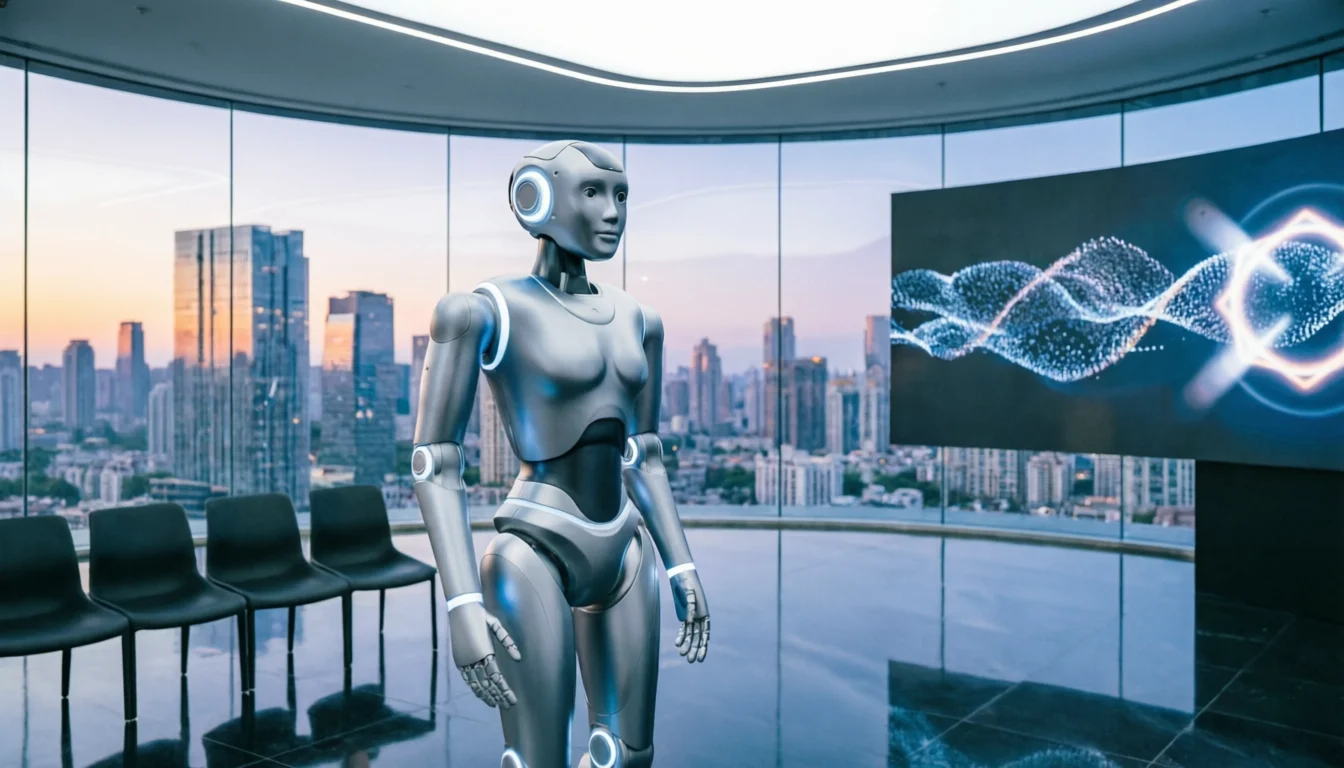
Faraday Future founder YT Jia unveils initial EAI robot shipments and marks the technology’s official launch in the U.S. market.
Faraday Future Intelligent Electric has reached what it describes as a historic turning point in its evolution—from a visionary mobility startup to a real-world Embodied AI (EAI) ecosystem company actively delivering robotic products into commercial environments. In its latest weekly business update, Founder and Global Co-CEO YT Jia outlined how the company has officially entered its first EAI robot delivery season of 2026, signaling the beginning of large-scale commercialization for its robotics strategy.
A Historic Shift: From Concept to Commercial Delivery
According to Jia, this moment represents more than just a product shipment. It marks the transition of FF’s EAI Robotics division into what he calls the “true delivery phase.” The company’s internal mantra—“Launch is sales, sales is delivery”—is now being put into practice.
The first batch of robots was delivered to Golden Hill, a premium Airbnb property operator with locations in Florida and Nevada. The pilot delivery includes two Master Ultra units and four Aegis units—comprising two Aegis Pro and two Aegis Ultra robots. While FF’s humanoid EAI robots, Futurist and Master, have already passed compliance certification, the Aegis line is expected to complete certification by the end of March. Once finalized, the four Aegis units delivered under the early pilot agreement will be formally recognized as completed deliveries.
This move places FF among the first companies to deliver humanoid robots and pre-deliver bionic robots into the U.S. market in commercial scenarios.
Entering a Blue-Ocean Market: Premium Airbnb Rentals
One of the most notable elements of FF’s strategy is its targeted entry into what Jia describes as a “blue-ocean” market: premium Airbnb home-sharing rentals.
By integrating robots into high-end short-term rental properties, FF is pioneering what it calls the “Robot + Vehicle + Airbnb Operator” real-world use case. This innovative approach combines hospitality, mobility, and robotics into a unified ecosystem.
The premium short-term rental industry is positioned as the first live application within FF’s “6-3-3 Industry Applications and Practical Values” framework. The rationale is straightforward: these environments offer high interaction frequency, strong social visibility, and measurable operational benefits—making them ideal proving grounds for embodied AI.
Delivery Targets and 2026 Expansion Plans
March marks the first official delivery month of the season. FF has set a shipping target of 20 EAI robots in March and 200 units for the first delivery season overall.
Looking ahead to the second half of 2026, the company plans to ramp up deliveries across two additional delivery seasons. Expansion will be demand-driven and scenario-specific, focusing on four priority sectors:
- Home-sharing short rental operators
- Premium restaurants
- High-end hotels
- Automotive dealerships
These sectors were selected for their strong service interaction requirements and potential to generate valuable real-world training data.
The Three-in-One EAI Robotics Ecosystem
At the core of FF’s strategy is what it calls its “Three-in-One” EAI Robotics eco-strategy. Unlike companies that focus solely on hardware, FF aims to deliver a full-stack ecosystem comprising:
- EAI Devices – The physical humanoid and bionic robots deployed in real-world environments.
- The EAI Brain & Open Developer Platform – A centralized intelligence system paired with open-source and developer tools.
- EAI Decentralized Data Factory Nodes – Infrastructure for collecting, processing, and optimizing real-world behavioral data under strict privacy and security compliance.
The company believes this integrated structure will create a flywheel effect: delivery drives usage, usage generates data, data improves intelligence, and improved intelligence boosts product value and sales.
Enhancing the Guest Experience
In the short-term rental use case, FF’s EAI robots are positioned as full-service concierge companions. During a guest’s stay, the robot can:
- Provide room tours
- Assist with check-in and checkout communication
- Offer reminders and service coordination
- Deliver educational and informational interactions
- Create entertainment and emotional engagement
The objective is to balance practical utility with social and emotional value. In lively hospitality environments, robots can elevate the guest experience by acting as interactive hosts, while simultaneously improving operational efficiency.
Empowering Users as Developers
Beyond hospitality, FF is also promoting its robots as collaborative development platforms. Guests who choose to engage more deeply can personalize the robot system during their stay by creating custom Agents and Skills Packages.
Through the company’s open-source developer framework, users can participate in cross-industry secondary development. Newly created Skills that become commercially viable can be monetized within the ecosystem, potentially forming revenue-sharing partnerships between FF and property operators.
This developer-first approach aligns with FF’s ambition to build not just products, but an evolving AI platform shaped by community input and real-world data.
A Data-Driven Closed Loop
Central to the strategy is FF’s decentralized data factory model. Under strict compliance and privacy safeguards, behavioral data generated during real-world interactions is processed to optimize service delivery.
Each deployment environment becomes a training node. Every guest interaction contributes to data accumulation, refining the EAI Brain’s capabilities and personalization accuracy. Over time, this “delivery-use-data-evolution” cycle is expected to accelerate product iteration and strengthen competitive advantage.
Business Value for Property Operators
For hospitality partners like Golden Hill, the value proposition extends beyond operational efficiency.
FF envisions the rise of “robot-themed vacation rentals,” properties differentiated by cutting-edge technology and experiential appeal. This can potentially:
- Drive social media visibility
- Increase booking traffic
- Enhance pricing power
- Reduce staffing and service costs
Additionally, operators can adopt a shared robot rental model, upgrading their offering from “shared vacation rentals” to “shared vacation rentals + shared robots.” This layered model aims to diversify revenue streams while modernizing the hospitality experience.
Linking Robotics and Electric Mobility
The robotics expansion is not isolated from FF’s broader strategy. Founded in 2014, Faraday Future initially focused on electric vehicle innovation. Its flagship vehicle, the FF 91, began deliveries in 2023, representing the brand’s ultra-luxury, high-performance positioning.
Meanwhile, its second brand, FX, targets higher-volume mainstream markets. The first FX model, Super One, is described as a first-class EAI-MPV, with deliveries scheduled to begin in 2026.
By integrating embodied AI across both vehicles and robotics, FF aims to unify mobility and intelligent service systems under a single technological umbrella.
Turning First-Mover Advantage into Scale
Jia emphasized that early market entry alone is not sufficient. The real objective is to convert first-mover advantage into scale advantage. Through continued deliveries, expanded scenarios, and capacity ramp-up, FF intends to build a data flywheel that reinforces product strength and accelerates adoption.
If successful, this strategy could position the company not only as an EV innovator but as a broader intelligent ecosystem provider spanning vehicles, robotics, AI platforms, and decentralized data infrastructure.