

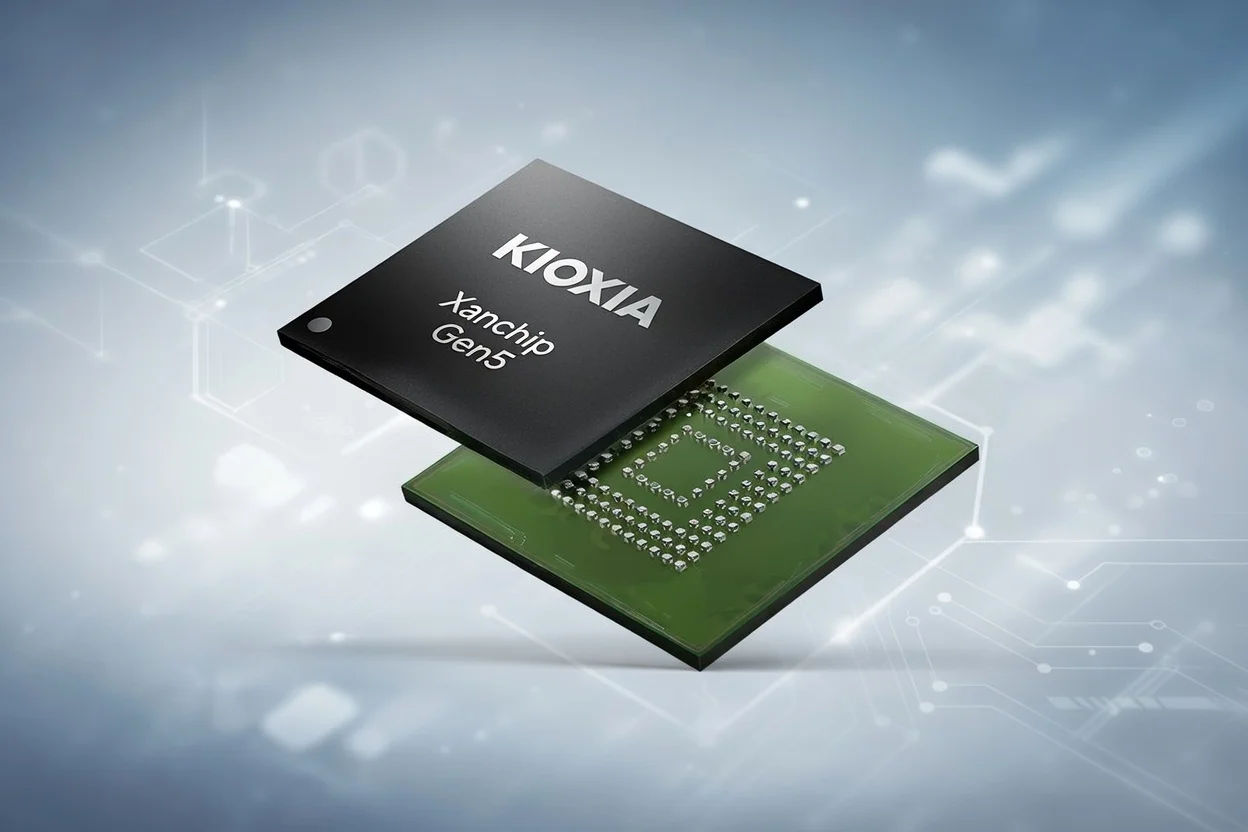
Kioxia Launches High-Capacity QLC UFS 4.1 Embedded Flash Memory for Mobile Devices
Kioxia Corporation, a globally recognized innovator in memory and storage technologies, has announced the commencement of sampling for its latest Universal Flash Storage (UFS) version 4.1 embedded memory devices built on advanced quadruple-level cell (QLC) technology, marking a significant milestone in the evolution of high-capacity storage solutions for modern digital devices.
These new embedded flash memory products are engineered specifically to address the growing demand for read-intensive workloads and large-scale storage requirements in mobile and emerging computing environments, and they are powered by Kioxia’s cutting-edge eighth-generation BiCS FLASH™ 3D flash memory technology, which represents a major leap forward in performance, efficiency, and architectural innovation.
Unlike traditional triple-level cell (TLC) UFS solutions, QLC-based UFS technology delivers substantially higher bit density by storing four bits of data per cell, enabling device manufacturers to integrate greater storage capacity within the same physical footprint while optimizing cost efficiency and scalability.
Historically, QLC technology has faced challenges related to endurance and performance, but recent advancements in controller design, error correction algorithms, and memory management techniques have enabled Kioxia to overcome these limitations, ensuring that QLC UFS can deliver competitive performance while maintaining reliability suitable for next-generation mobile and computing applications.
Building on these technological advancements, Kioxia’s new QLC UFS 4.1 embedded memory devices deliver remarkable improvements in overall performance metrics when compared with the company’s previous generation of QLC UFS products based on UFS 4.0 and sixth-generation BiCS FLASH™ technology, with sequential write speeds improved by approximately 25 percent, random read performance enhanced by around 90 percent, and random write performance increased by as much as 95 percent, demonstrating Kioxia’s ability to significantly enhance responsiveness and data throughput even within the constraints of high-density QLC memory architectures.
In addition to raw performance gains, the new devices also exhibit substantial improvements in Write Amplification Factor (WAF), achieving up to a 3.5-times enhancement when the WriteBooster feature is disabled, which contributes to improved efficiency, longer lifespan, and more stable performance under sustained workloads, all of which are critical factors for modern devices that rely heavily on storage subsystems for multitasking, media processing, artificial intelligence workloads, and real-time data access.
Designed primarily with smartphones and tablets in mind, Kioxia’s QLC UFS 4.1 embedded memory devices are positioned to support the next wave of mobile innovation, where users increasingly demand higher storage capacities to accommodate ultra-high-resolution video, immersive gaming experiences, advanced photography, cloud-synchronized applications, and AI-driven features that require rapid data access and storage efficiency.
Beyond mobile devices, the new QLC UFS solutions are also optimized to address the needs of emerging product categories that require both high capacity and robust performance, including personal computers, networking equipment, augmented and virtual reality systems, Internet of Things devices, and AI-enabled platforms, reflecting the broader industry trend toward unified storage technologies that can scale across multiple device ecosystems.
By offering capacities of 512 gigabytes and 1 terabyte, Kioxia’s new UFS 4.1 devices provide manufacturers with flexible options to design products that meet a wide range of performance and storage requirements, from mainstream consumer devices to premium flagship products that demand maximum storage capacity and responsiveness.
These devices integrate Kioxia’s advanced BiCS FLASH™ 3D flash memory with an optimized controller within a JEDEC-standard package, ensuring compatibility with industry specifications while delivering enhanced efficiency and reliability. A key technological highlight of Kioxia’s eighth-generation BiCS FLASH™ 3D flash memory is the introduction of CMOS directly Bonded to Array (CBA) technology, an architectural innovation that fundamentally redefines flash memory design by enabling tighter integration between the memory array and peripheral circuitry, resulting in improved performance, reduced latency, enhanced power efficiency, and greater scalability for future storage solutions.
This architectural advancement underscores Kioxia’s long-term commitment to pushing the boundaries of flash memory technology and delivering solutions that align with the rapidly evolving requirements of digital transformation, artificial intelligence, and data-driven applications. As data consumption continues to grow exponentially across consumer electronics, enterprise systems, and connected devices, the introduction of QLC-based UFS 4.1 embedded memory represents a strategic response to the industry’s need for higher-capacity, cost-effective, and energy-efficient storage solutions that can support increasingly complex workloads without compromising user experience.
By leveraging its deep expertise in flash memory innovation and system-level optimization, Kioxia is positioning its QLC UFS 4.1 products as a foundational technology for next-generation devices that demand both scale and speed, reinforcing its role as a key contributor to the global memory ecosystem. The sampling of these new embedded memory devices marks an important step toward commercial adoption, providing device manufacturers with early access to advanced storage technology that can accelerate product development cycles and enable new use cases across mobile, computing, and intelligent systems.
As the industry transitions toward more data-intensive applications and intelligent device architectures, Kioxia’s QLC UFS 4.1 embedded memory devices are expected to play a pivotal role in shaping the future of storage technology, offering a compelling balance of capacity, performance, efficiency, and innovation that addresses the evolving needs of consumers and enterprises alike while setting a new benchmark for high-density embedded storage in the UFS ecosystem.
Source Link:https://www.businesswire.com/