
Enhancing machining accuracy by correcting tool-induced deformation in real time using advanced digital twin technology
Mitsubishi Electric Corporation has announced a significant technological breakthrough in the field of advanced manufacturing. In collaboration with RWTH Aachen University in Germany, the company has successfully developed an innovative digital twin–based solution designed to correct machining errors in real time for computer numerical control (CNC) machine tools.
This cutting-edge development represents a major step forward in precision engineering and smart manufacturing. The newly introduced technology leverages the concept of a digital twin—a virtual representation of a physical system—to monitor, predict, and actively compensate for errors that occur during machining operations. According to testing results, the system is capable of reducing machining errors caused by subtle deformation of workpieces by as much as 50%. Such deformation typically occurs due to the forces exerted by cutting tools during high-precision operations.
Transforming CNC Machining with Real-Time Intelligence
CNC machine tools are widely used across industries such as automotive, aerospace, and electronics manufacturing due to their ability to produce highly accurate and complex parts. However, even minor deviations in machining—often caused by mechanical stress, thermal expansion, or tool pressure—can result in defective parts. These inaccuracies not only increase production costs but also lead to material waste and inefficiencies.
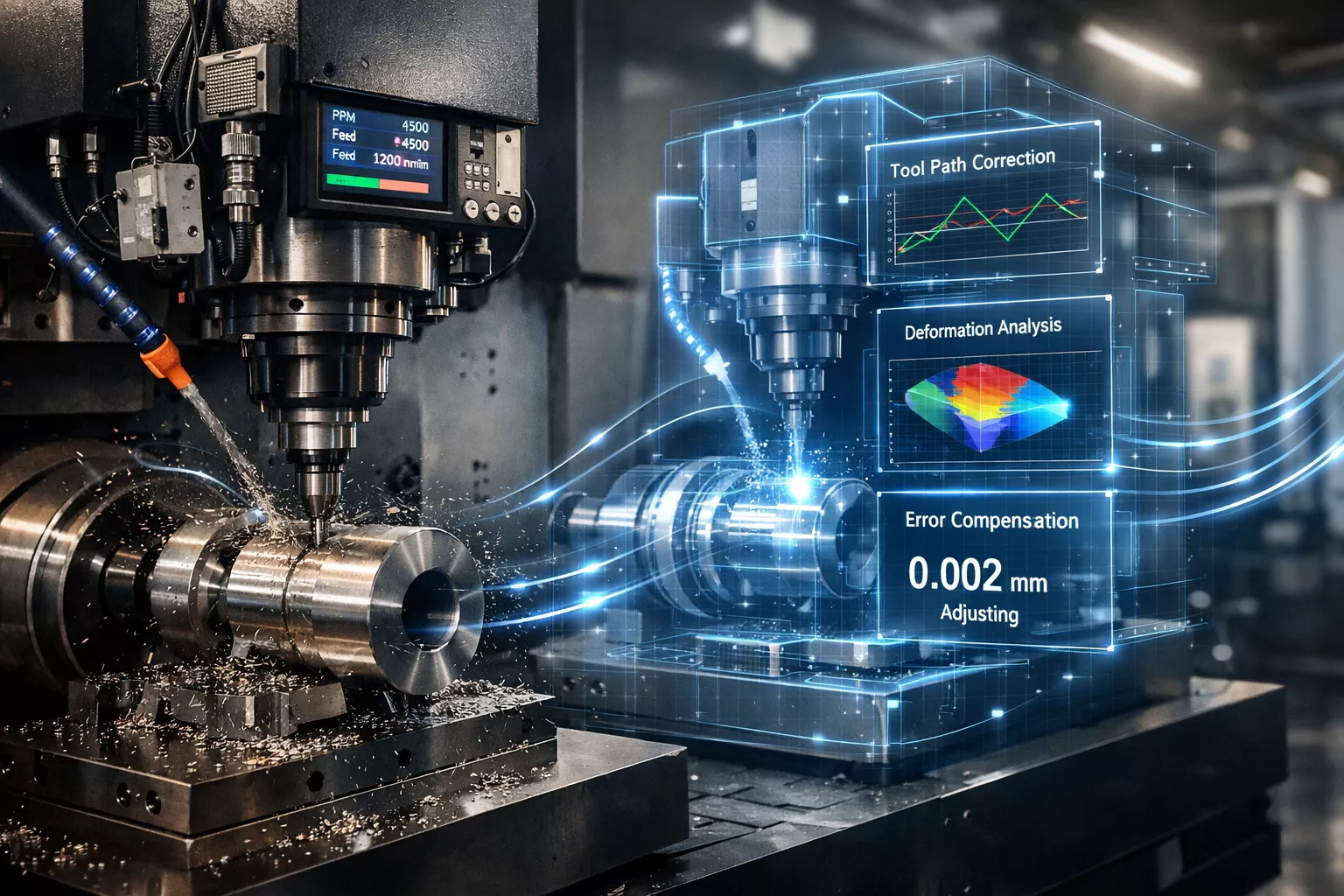
The newly developed digital twin technology directly addresses these challenges by enabling real-time error detection and correction. Unlike traditional methods that rely on post-process inspection or offline simulations, this system operates dynamically during the machining process. By continuously analyzing data and adjusting parameters, it ensures that the final output meets the desired specifications with higher consistency.
Collaborative Innovation and Research Timeline
The development of this technology was the result of a three-year joint research initiative conducted between April 2023 and March 2026. During this period, Mitsubishi Electric and RWTH Aachen University combined their expertise in industrial automation, data science, and digital modeling.
RWTH Aachen University, widely recognized for its leadership in digital twin research and advanced engineering, played a crucial role in developing the underlying modeling techniques. Meanwhile, Mitsubishi Electric contributed its deep knowledge of CNC systems and industrial hardware integration.
A key focus of the collaboration was the implementation of online edge computing. By utilizing high-speed processing units located close to the machine tools, the system can process large volumes of data instantly without relying on cloud-based infrastructure. This ensures minimal latency and enables real-time feedback, which is essential for effective error compensation.
The Power of a Compact Physical Model
At the core of this innovation lies a proprietary compact physical model that forms the digital twin. Unlike complex simulation models that require extensive computational resources, this model is designed using a minimal set of equations while still maintaining high accuracy.
The model is trained using vast amounts of operational data collected from CNC machines. This includes parameters such as:
- Axis positions
- Motor currents
- Cutting forces
- Machine dynamics
These data points are captured at a high sampling rate, allowing the system to detect even the smallest variations during machining. Advanced data processing techniques are then used to extract only the most relevant information needed to estimate potential errors.
By simplifying the model while retaining essential characteristics, the system achieves a balance between computational efficiency and predictive accuracy. This is particularly important for real-time applications where speed and responsiveness are critical.
Real-Time Feedback and Error Compensation
One of the most notable features of this technology is its ability to feed calculated corrections directly back into the CNC control system. As the machining process progresses, the digital twin continuously compares expected outcomes with actual conditions.
When discrepancies are detected—such as slight deformation caused by tool pressure—the system immediately adjusts machining parameters. These adjustments may include changes in tool path, speed, or force, ensuring that the final product remains within tolerance limits.
Real-world testing on CNC machine tools has demonstrated the effectiveness of this approach. The results showed a reduction in machining errors by up to 50%, particularly in scenarios where workpiece deformation is a common issue.
Benefits for Productivity and Sustainability
The implications of this innovation extend far beyond improved accuracy. By significantly reducing the number of defective parts, manufacturers can achieve:
- Higher productivity: Fewer errors mean less rework and faster production cycles.
- Cost savings: Reduced material waste and lower operational costs.
- Improved quality consistency: Enhanced surface finish and dimensional accuracy.
- Environmental benefits: Lower scrap rates contribute to more sustainable manufacturing practices.
In today’s competitive industrial landscape, these advantages can provide a substantial edge for manufacturers seeking to optimize efficiency while minimizing environmental impact.
Advancing the Future of Smart Manufacturing
This development aligns with the broader trend of Industry 4.0, where digital technologies are integrated into manufacturing processes to create intelligent, autonomous systems. The use of digital twins, in particular, is becoming increasingly important as companies strive to achieve higher levels of precision and adaptability.
By combining real-time data acquisition, edge computing, and advanced modeling, Mitsubishi Electric and RWTH Aachen University have demonstrated how digital twins can move beyond simulation and become active participants in the manufacturing process.