
Ascend Elements earns top honor from Polish Investment and Trade Agency for its groundbreaking battery materials recycling and refining project in Europe
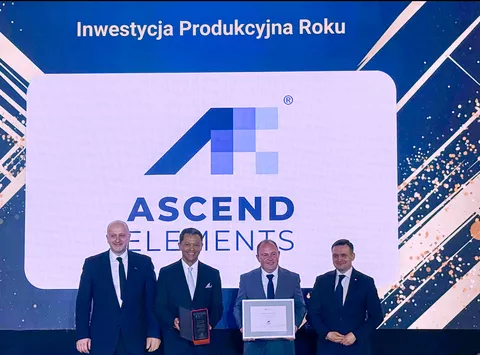
The Polish Investment and Trade Agency (PAIH) has recognized Ascend Elements’ Apex 2 project as Manufacturing Investment of the Year, underscoring the growing importance of sustainable battery production and circular economy initiatives within Europe. This distinction reflects not only the scale of the investment but also its strategic relevance to the European Union’s long-term goals of energy transition, resource independence, and industrial innovation.
At the heart of this recognition is the Apex 2 project—an ambitious undertaking by Ascend Elements to construct the European Union’s first fully integrated battery materials refining facility. The plant will focus on transforming used lithium-ion batteries into high-value cathode materials through the company’s proprietary Hydro-to-Cathode® technology. This advanced hydrometallurgical process enables the direct conversion of battery waste, often referred to as “black mass,” into battery-grade lithium carbonate and precursor cathode active material (pCAM), both of which are critical inputs in the manufacturing of new lithium-ion batteries.
The significance of the Apex 2 project is further reinforced by substantial financial backing from the Polish government. The initiative has been awarded approximately $320 million (around PLN 1.22 billion) in funding, marking one of the largest grants ever issued by Poland’s Ministry of Development and Technology. This level of support highlights the government’s commitment to fostering high-tech, sustainable industries and positioning Poland as a key player in Europe’s battery value chain.
According to Linh Austin, President and CEO of Ascend Elements, the Apex 2 project represents far more than the establishment of a single production facility. It serves as a proof point that Europe can lead globally in building a truly circular and low-carbon battery ecosystem. By deploying Hydro-to-Cathode® technology in Poland, the company aims to industrialize the recycling of used batteries into new critical materials, thereby reducing reliance on virgin resource extraction and minimizing environmental impact. This approach not only enhances sustainability but also strengthens the European Union’s strategic autonomy in securing critical raw materials.
The award was formally announced during the PAIH Investor Gala 2026, held in Warsaw. This annual event brings together key stakeholders from government institutions, international investors, local authorities, and special economic zones to celebrate major investment projects that contribute to Poland’s economic development. The recognition of Apex 2 at this prestigious gathering emphasizes the vital role of foreign direct investment in driving innovation, creating high-quality employment opportunities, and supporting the growth of future-oriented industries.
Paweł Pudłowski, Vice President of the Management Board at PAIH, highlighted Poland’s increasing attractiveness as a destination for cutting-edge investments in clean technology and battery manufacturing. He noted that Ascend Elements’ decision to locate such an advanced project in Poland not only strengthens the country’s position within the European battery supply chain but also contributes to the creation of highly skilled jobs. Furthermore, the project supports broader EU efforts to establish secure and sustainable supply chains for critical raw materials, reducing dependence on imports from geopolitically sensitive regions.
Technically, the Apex 2 facility will be a state-of-the-art production hub designed to refine essential cathode raw materials recovered from spent lithium-ion batteries. Through advanced processing techniques, the plant will produce battery-grade lithium carbonate (Li₂CO₃) and pCAM, both of which are indispensable for the production of cathode active materials (CAM). These materials form the core of lithium-ion batteries used in electric vehicles (EVs) and stationary energy storage systems, making them crucial for the transition to renewable energy and electrified transportation.
The introduction of Hydro-to-Cathode® technology into the European market represents a significant milestone. Unlike traditional recycling methods, which often involve energy-intensive processes and result in lower-quality outputs, this technology enables the efficient recovery and direct reuse of battery materials. By closing the loop in battery production, the Apex 2 project contributes to a more sustainable and resource-efficient industrial model.
Importantly, the project aligns closely with the objectives of the European Union’s EU Critical Raw Materials Act and broader circular economy policies. By ensuring that strategic metals are recovered and processed within the EU rather than exported as waste, the initiative enhances resource security and reduces environmental impact. It also supports the EU’s carbon neutrality targets by promoting low-emission production processes and minimizing the need for long-distance transportation of raw materials.
Michał Jaros, Secretary of State at the Ministry of Development and Technology, described the Apex 2 project as a model example of the type of high-value investment needed to strengthen Poland’s role in Europe’s clean energy economy. He emphasized that the combination of advanced recycling capabilities and next-generation cathode material production not only secures critical resources but also builds a more resilient industrial base for both Poland and the European Union as a whole.
From a global perspective, Ascend Elements is already making significant strides in battery material production. In 2025, the company began producing battery-grade lithium carbonate at a facility in the United States with an annual capacity of 3,000 tons. Looking ahead, it plans to scale its global production capacity to more than 15,000 tons per year by 2027. The transfer of this proven technology to Poland through the Apex 2 project is expected to play a crucial role in addressing Europe’s growing demand for cathode precursor materials.
Ultimately, the Apex 2 project stands as a transformative initiative that bridges sustainability, innovation, and economic development. By enabling the large-scale recycling of lithium-ion batteries into high-quality materials, it not only supports the transition to clean energy but also establishes a more secure and self-sufficient supply chain within Europe. As the demand for electric vehicles and renewable energy storage continues to rise, investments like Apex 2 will be instrumental in shaping the future of the global battery industry and advancing the principles of a circular, low-carbon economy.