

TeraSignal’s TS9802 Intelligent TIA earns industry recognition for advancing high-performance optical receiver technology with integrated digital eye monitoring.
TeraSignal, a recognized innovator in intelligent interconnect technology, has announced that its TS9802 Intelligent Transimpedance Amplifier (TIA), integrated with TSLink™ Digital Eye Monitoring (DEM), has earned a 4.0 rating in the 2026 Lightwave + BTR Innovation Reviews. This recognition places the TS9802 among the most impactful advancements in the Communications Semiconductors and Electrical ICs category, underscoring its importance in shaping the next generation of optical networking, hyperscale data centers, and high-performance computing systems.
As global demand for artificial intelligence (AI), machine learning (ML), and cloud-based services continues to accelerate, the underlying infrastructure supporting these workloads is undergoing a fundamental transformation. Data centers are scaling rapidly, with operators seeking higher bandwidth, lower latency, and improved energy efficiency. Optical interconnect technology sits at the heart of this transformation, enabling high-speed data transmission between servers, switches, and storage systems. However, traditional approaches to optical receiver design—particularly those relying on digital signal processors (DSPs)—have begun to show limitations in terms of power consumption and complexity.
The TS9802 Intelligent TIA represents a significant breakthrough in addressing these challenges. Designed specifically for next-generation linear optical receiver architectures, the device enables hyperscale operators to deploy 200G per lane optical links while maintaining the efficiency benefits of DSP-free designs. This is especially critical as data centers move toward 1.6 terabit (1.6T) optical interconnects, where power efficiency becomes a key constraint in scaling infrastructure.
In recent years, there has been a clear industry shift toward alternative optical architectures such as Linear Pluggable Optics (LPO), Near-Package Optics (NPO), and Co-Packaged Optics (CPO). These approaches eliminate or reduce reliance on DSPs, resulting in lower latency and significantly reduced power consumption. However, this shift has introduced a major challenge: the loss of real-time diagnostic capabilities traditionally provided by DSP-based systems. Without these diagnostics, operators face reduced visibility into signal integrity, making it more difficult to ensure reliable performance at scale.
TeraSignal addresses this critical gap with its proprietary TSLink™ Digital Eye Monitoring technology, which is integrated directly into the TS9802 TIA. This innovation restores real-time link visibility without requiring external DSPs or microcontrollers. By embedding digital monitoring capabilities within the analog receive path, the TS9802 enables operators to observe and analyze signal quality in real time, even in fully linear optical systems.
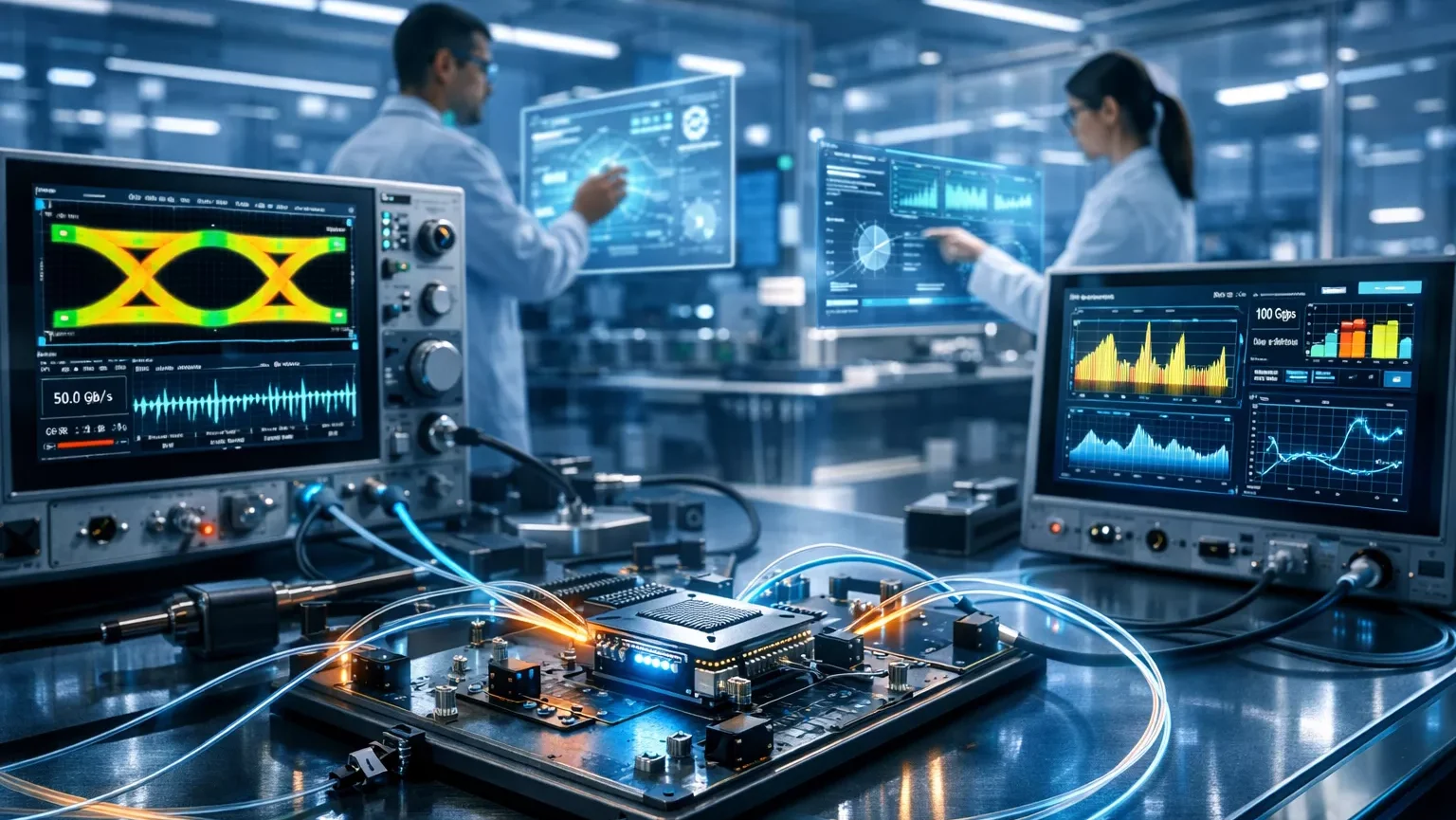
One of the most important features of TSLink DEM is its ability to estimate eye diagrams digitally. Eye diagrams are essential tools in high-speed communications, providing a visual representation of signal integrity and timing margins. Traditionally, generating and analyzing eye diagrams required complex instrumentation or DSP-based processing. With TSLink, this capability is built directly into the hardware, allowing continuous monitoring without additional overhead.
In addition to eye diagram estimation, the TS9802 provides bit-error-rate (BER) diagnostics, enabling operators to quantify link performance and detect potential issues before they impact system reliability. This level of insight is particularly valuable in large-scale AI clusters, where even minor signal degradations can lead to significant performance bottlenecks.
The TS9802 also incorporates adaptive equalization technology, which dynamically compensates for channel impairments such as printed circuit board (PCB) losses and optical dispersion. As data rates increase, these impairments become more pronounced, potentially degrading signal quality. Adaptive equalization ensures that the receiver can maintain optimal performance across varying conditions, reducing the need for manual tuning and improving overall system robustness.
Another key advantage of the TS9802 is its fully differential architecture, which provides superior immunity to cross-talk and electromagnetic interference. This is especially important in high-density data center environments, where multiple high-speed signals operate in close proximity. By minimizing interference, the TS9802 helps ensure consistent and reliable data transmission.
The device also features a linear phase response and stable input impedance across its entire bandwidth, further enhancing signal integrity. These characteristics are critical for maintaining accurate signal reconstruction, particularly in high-speed PAM4 (Pulse Amplitude Modulation with four levels) systems, which are widely used in modern optical communication.
To support continuous monitoring of optical input power, the TS9802 includes an integrated Received Signal Strength Indicator (RSSI) and automatic gain control (AGC). These features allow the system to adjust dynamically to changing conditions, ensuring consistent performance and preventing signal saturation or degradation.
From a physical design perspective, the TS9802 is offered in a compact bumped-die form factor, making it ideal for high-density optical module integration. This is particularly relevant for next-generation data center architectures, where space and thermal constraints are critical considerations. The compact design allows for greater scalability and flexibility in deploying advanced optical interconnect solutions.
Dr. Armond Hairapetian, Founder and CEO of TeraSignal, emphasized the significance of this innovation, stating that the TS9802 demonstrates how intelligent analog design can transform the deployment of next-generation optical interconnects. By integrating digital eye monitoring directly into the receive path, the company enables hyperscale operators to deploy 1.6T linear optical links with the visibility, reliability, and operational confidence required for large-scale AI infrastructure.
The recognition from the Lightwave + BTR Innovation Reviews further validates the impact of the TS9802 on the industry. The program evaluates cutting-edge technologies that are driving advancements in optical networking and communications, and a 4.0 rating highlights the product’s strong performance, innovation, and potential for real-world deployment.
The TS9802 Intelligent TIA is currently available to select partners and customers, allowing early adopters to begin integrating this technology into their systems. As the demand for high-speed, energy-efficient optical interconnects continues to grow, solutions like the TS9802 are expected to play a crucial role in enabling the next wave of data center innovation.
TeraSignal will also showcase its TSLink-enabled intelligent interconnect technologies at the Optical Fiber Communication (OFC) Conference in 2026. The event, taking place from March 17 to 19 at the Los Angeles Convention Center, provides an opportunity for industry professionals to experience live demonstrations and explore the capabilities of the TS9802 firsthand.
In conclusion, the TS9802 Intelligent TIA represents a major step forward in optical receiver technology, combining the efficiency of DSP-free architectures with the critical diagnostics needed for reliable operation. By bridging the gap between performance and visibility, TeraSignal is helping to redefine the future of optical interconnects, enabling scalable, efficient, and intelligent infrastructure for the AI-driven era.