
UMA (Universal Mechanical Assistant), a newly launched robotics intelligence company founded by former leaders and innovators from Tesla, Google DeepMind, Nvidia, and Hugging Face, officially announced its entry into the global market today. The company is driven by a bold mission: to bring advanced artificial intelligence out of purely digital domains and into the physical world. UMA aims to develop humanoid and mobile robotic systems capable of performing real tasks in real environments—and doing so at scale, reliably and safely.
The founders of UMA played central roles in shaping many of the pivotal breakthroughs in modern AI over the past decade, including advancements in deep learning, autonomous robotics, large-scale training systems, and open-source development. They share a unified belief that the next frontier of AI is not about improving chatbots or refining virtual assistants—it is about enabling intelligent machines to operate autonomously in environments filled with uncertainty, complexity, and physical interaction. UMA sees the future of AI not on screens, but in warehouses, hospitals, laboratories, manufacturing facilities, and homes. The company is designed to accelerate this transition, moving the industry from digital intelligence toward true physical autonomy.
AI is Leaving the Screen and Entering the Real World
The last decade has been defined by major leaps in generative AI, multimodal systems, and highly capable language models—tools that understand text, images, and speech. But the next decade, UMA argues, will be defined by robotics: intelligent systems that can perceive the world, reason, decide, physically manipulate objects, and collaborate with humans in complex settings.
Market forecasts reinforce this transformation. Analysts predict that the humanoid and mobile robotics sector will expand rapidly, reaching an estimated $243 billion in value by 2035 and more than $5 trillion globally by 2050. Several structural forces are driving this momentum:
- Persistent global labor shortages across logistics, manufacturing, and healthcare
- Rising operational costs and efficiency demands
- Increasing pressure for resilient, flexible, and always-on production environments
- Growing societal need for assistance as the world’s population ages
UMA’s founders argue that the industry currently lacks the type of robotics intelligence required to fully meet these needs. What is required is a new generation of AI: one that is deeply data-driven, adaptable to radically diverse tasks, continuously self-improving, and fundamentally safe to operate alongside human workers.
Founded by Leaders Who Have Already Defined the AI Frontier
The founding team behind UMA brings together decades of achievements across academic research, industrial-scale deployment, and real-world robotics system development:
- Rémi Cadene – A pivotal contributor to Tesla Autopilot and the Optimus humanoid robot program, and co-creator of the LeRobot open-source robot learning framework at Hugging Face.
- Pierre Sermanet – A respected deep learning and robotics researcher with more than twenty years of experience at NYU and Google DeepMind, where he helped push the boundaries of perception and control learning.
- Simon Alibert – Co-founder of LeRobot and an expert in scalable AI training infrastructure and robotics learning systems.
- Robert Knight – A veteran roboticist with over 25 years in humanoid robot engineering and creator of the open-source SO-100 robot used widely in research environments.
Individually, they have shaped some of the most influential technological advances of the past decade. Collectively, they share a commitment to creating robotics that are not merely impressive in controlled demonstrations, but durable, safe, and reliable in real production environments.
Their guiding ethos is straightforward: the world does not need better demo videos—it needs robots that work.
Solving Global Challenges That Demand Physical AI
The pressures driving robotics adoption are broad, urgent, and structural—not temporary problems that will fade on their own.
In logistics and warehousing, labor accounts for as much as 50% of total operating costs, and annual employee turnover in U.S. facilities frequently exceeds 40%, far above national averages. Constant churn means constant retraining and constant inefficiency.
In healthcare, workforce shortages are approaching crisis levels. Global health systems are projected to face a deficit of nearly 10 million healthcare workers by 2030, including 4.8 million nurses and midwives—a shortage that threatens essential care delivery worldwide.
And demographic transformation is accelerating demand for physical support systems. The population of people aged 65 and older is already 10% of the world’s total, and is projected to reach 16% (1.6 billion people) by 2050. Aging societies will require massive expansions in care automation, mobility assistance, and service robotics.
These forces have real consequences: hospitals risk understaffing, supply chains risk breaking, and millions of older adults risk losing independence.
UMA sees robotics not as a futuristic luxury, but as a critical tool for human resilience—machines that take on physical strain, repetitive manual tasks, and operational hazards so that people can focus on uniquely human strengths such as creativity, empathy, and judgment.
Two Complementary Systems for Real-World Deployment
UMA is currently developing two robotics systems designed to address different categories of physical work:
- A mobile industrial robot equipped with dual arms, intended for high-throughput and precision environments such as warehouses and assembly lines. It is designed to handle tasks requiring strength, dexterity, repeatability, and continuous operation.
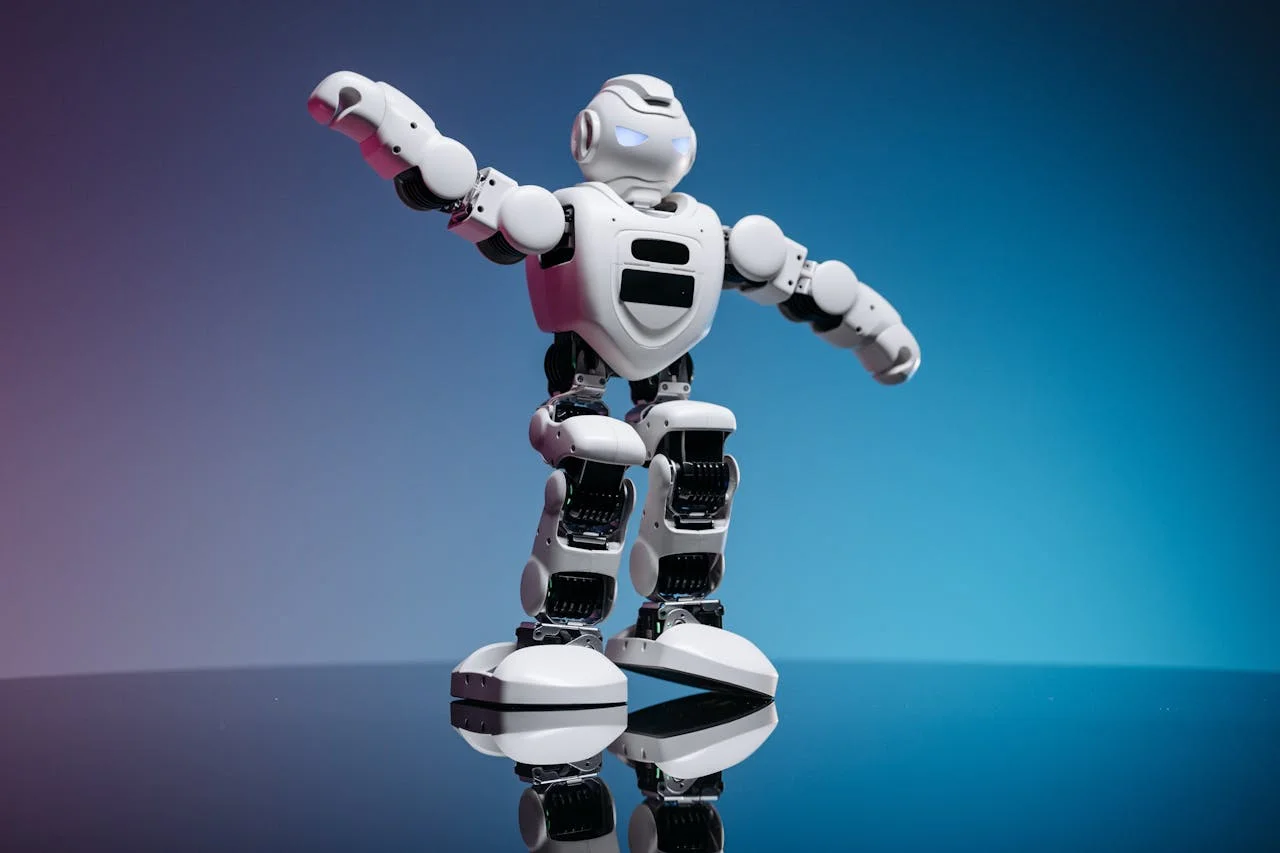
- A compact humanoid robot, built to navigate human-oriented spaces and work directly alongside people. Its form factor enables it to move through doorways, use tools, interact safely with humans, and adapt to environments not originally designed for machines.
Together, these platforms provide a practical roadmap for staged deployment, advancing productivity today while building toward fully autonomous humanoid robotics tomorrow.
Human-Centered Design and a Civilian-First Vision
UMA emphasizes durability, repairability, and long-term safety as core design principles. Their systems are intended to be lightweight, maintainable, and built for continuous use in real environments. The company commits to pursuing robotics exclusively for civilian purposes and rejects military applications.
The company’s vision is grounded in a simple philosophy: robotics should expand human capability, not replace it. They aim to empower workers, protect health and time, and create new possibilities previously limited by physical constraints.
Built for Global Scale, Supported by Global Leaders
UMA is now recruiting engineers, researchers, product leaders, and domain specialists from around the world. The company believes that excellence requires diversity of thought and that world-class innovation is built by teams with varied backgrounds, cultures, and technical perspectives.
UMA is backed by a distinguished group of global investors including Greycroft, Relentless, Unity Growth, >Commit, Factorial, ALM Ventures, and Drysdale. The company also has the support of prominent figures in AI and technology such as Olivier Pomel, Yann LeCun, Thomas Wolf, Soumith Chintala, and Nicolas Rosberg, reflecting broad confidence in UMA’s mission and strategic direction.
A Future Where Physical AI Works alongside Humanity
UMA believes that intelligent robotics will soon be as foundational to daily life as computers and smartphones are today. Their vision is a world where machines handle dangerous, exhausting, and repetitive labor, while people focus on complex, creative, and deeply human work.
Source Link:https://www.businesswire.com/news