

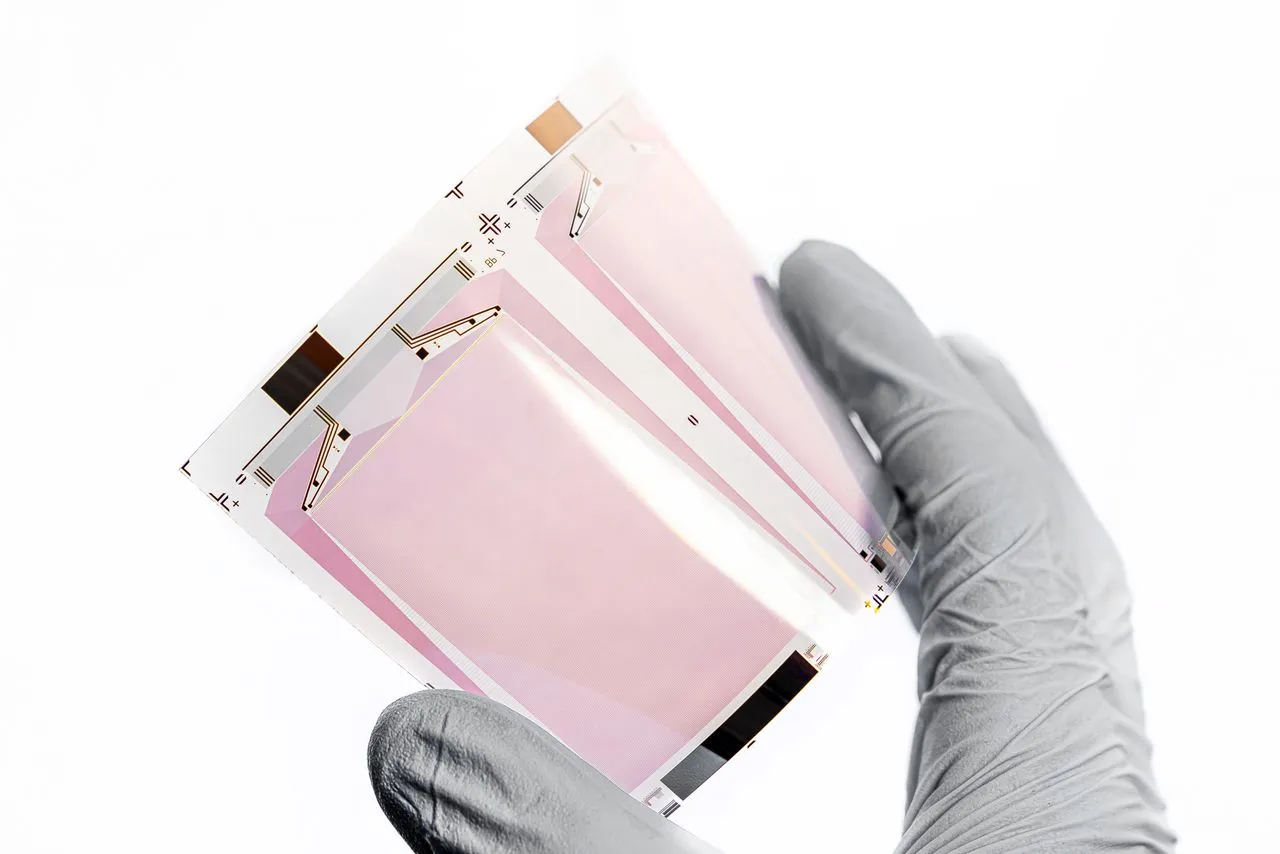
Nippon Electric Glass Co, a leading glass technology company, has developed “BDX-3,” a new ultra-thin cover glass under its Starveil™ brand for use in space applications.
Designed to meet the demanding requirements of spaceborne equipment, BDX-3 provides improved protection against ultraviolet (UV) radiation while reducing radiation-induced discoloration. Compared with NEG’s existing BDX-2 glass, the new material offers enhanced UV shielding performance while helping maintain optical transmittance after prolonged exposure to radiation.
Although BDX-3 is primarily designed for low Earth orbit (LEO) applications, its enhanced radiation and UV protection capabilities also make it suitable for equipment operating in medium Earth orbit (MEO) and high Earth orbit. This broader operating range expands the potential applications of NEG’s ultra-thin glass technology across a wider variety of satellite and spaceborne systems.
NEG has made samples of BDX-3 available for purchase and is working toward commercial adoption of the new product in satellites and other spaceborne equipment.
Satellites and other spaceborne equipment operate under environmental conditions that are significantly more demanding than those encountered on Earth. In addition to extreme temperature fluctuations and vacuum conditions, equipment in orbit is continuously exposed to intense ultraviolet radiation and other forms of radiation.
These conditions can affect the performance and durability of sensitive components. For optical systems and solar cells in particular, maintaining light transmission and optical performance over an extended period is essential.
Cover glass plays a critical role in protecting precision equipment from the space environment. However, the glass itself must maintain its optical characteristics even after prolonged exposure to radiation. Radiation-induced discoloration can reduce light transmittance and potentially affect the efficiency or performance of the components underneath.
BDX-3 has been developed specifically to address these challenges by combining reduced radiation-induced discoloration with enhanced UV shielding performance.
Different satellite missions operate at different orbital altitudes depending on their intended applications.
Low Earth orbit (LEO) is widely used for applications such as Earth observation, remote sensing, communications, and other satellite services. Medium Earth orbit (MEO) is commonly associated with positioning and navigation systems, while high Earth orbit is used for applications including communications and weather observation.
Each environment presents different radiation exposure and performance requirements. A cover glass that performs effectively in one orbital environment may not necessarily provide the same level of protection in another.
BDX-3 is primarily intended for LEO applications but has been designed with performance characteristics that allow it to be considered for MEO and high Earth orbit applications as well. This versatility enables satellite and equipment manufacturers to consider a single ultra-thin glass technology across a broader range of space missions.
One of the NEG key features of BDX-3 is its ability to reduce radiation-induced discoloration.
When cover glass is exposed to radiation over an extended period, changes in the material can cause discoloration. This can reduce the amount of light transmitted through the glass and affect the performance of optical components or solar cells.
BDX-3 is engineered to be less prone to this type of discoloration, helping maintain light transmittance throughout prolonged exposure to the space environment.
This characteristic is particularly important for satellite applications where components are expected to operate reliably for extended periods. By helping preserve optical performance, BDX-3 can contribute to the long-term reliability and efficiency of spaceborne equipment.
BDX-3 also delivers improved UV shielding performance compared with NEG’s BDX-2.
At a glass thickness of 100 micrometers, BDX-3 achieves a transmittance of approximately 0.1% at 300 nm, compared with 20% for BDX-2. At 280 nm, both BDX-2 and BDX-3 provide approximately 0.1% transmittance.
At 400 nm, which is near the boundary between ultraviolet and visible light, BDX-3 provides approximately 91% transmittance compared with 92% for BDX-2.
These NEG characteristics demonstrate BDX-3’s ability to significantly reduce UV transmission at key ultraviolet wavelengths while maintaining high transmission in the near-visible range.
Lower transmittance at UV wavelengths means less ultraviolet radiation passes through the glass, providing additional protection for the sensitive components beneath it.
Weight and size are important considerations in satellite and spacecraft design. Every component must be carefully optimized to meet mission requirements while minimizing unnecessary mass.
BDX-3 retains the NEG ultra-thin characteristics of the Starveil™ product family, with a minimum thickness of just 30 micrometers. Despite its thin profile, the material is designed to provide the protective and optical characteristics required for demanding space applications.
The glass is available in sizes of up to 800 mm wide by 2,000 mm long, providing flexibility for manufacturers developing different types of satellite components and spaceborne equipment.
Compared with BDX-2, the new BDX-3 provides several important performance improvements.
| Specification | BDX-2 | BDX-3 |
|---|---|---|
| Transmittance at 400 nm* | 92% | 91% |
| Transmittance at 300 nm* | 20% | 0.1% |
| Transmittance at 280 nm* | 0.1% | 0.1% |
| Radiation-induced discoloration | Discoloration occurs | Less prone to discoloration |
| Minimum thickness | 30 µm | 30 µm |
| Maximum size | 800 × 2,000 mm | 800 × 2,000 mm |
| Primary operating environment | Primarily LEO | Primarily LEO; also MEO and high Earth orbit |
*280 nm and 300 nm are ultraviolet wavelengths, while 400 nm is near the boundary between ultraviolet and visible light. Lower transmittance indicates that less light at the corresponding wavelength passes through the glass.
Starveil™ is NEG’s brand of ultra-thin cover glass developed for a broad range of spaceborne equipment, including satellite solar cells.
The product family is designed to provide excellent UV shielding performance while protecting sensitive equipment from harsh space environments. By helping reduce exposure to damaging radiation, Starveil™ glass can contribute to longer service life and sustained component performance.
The NEG Starveil™ lineup is designed to address different orbital environments and optical transmittance requirements, giving satellite and equipment manufacturers greater flexibility when selecting cover glass for specific missions.
The development of BDX-3 reflects NEG’s continued efforts to advance materials technology for the rapidly evolving space industry. As satellite constellations, Earth observation systems, communications networks, navigation infrastructure, and other space-based applications continue to expand, demand is growing for lightweight and high-performance materials capable of operating reliably in extreme environments.
With its combination of ultra-thin construction, improved UV shielding, and reduced radiation-induced discoloration, BDX-3 is positioned to support a broader range of satellite and spaceborne applications.
Samples of BDX-3 are now available for purchase, and NEG aims to advance the product toward commercial adoption in satellites and other space equipment. Through the continued development of the Starveil™ portfolio, NEG is working to provide advanced glass solutions that help protect critical components and support the long-term performance of next-generation space systems.
Source link: https://www.businesswire.com/