


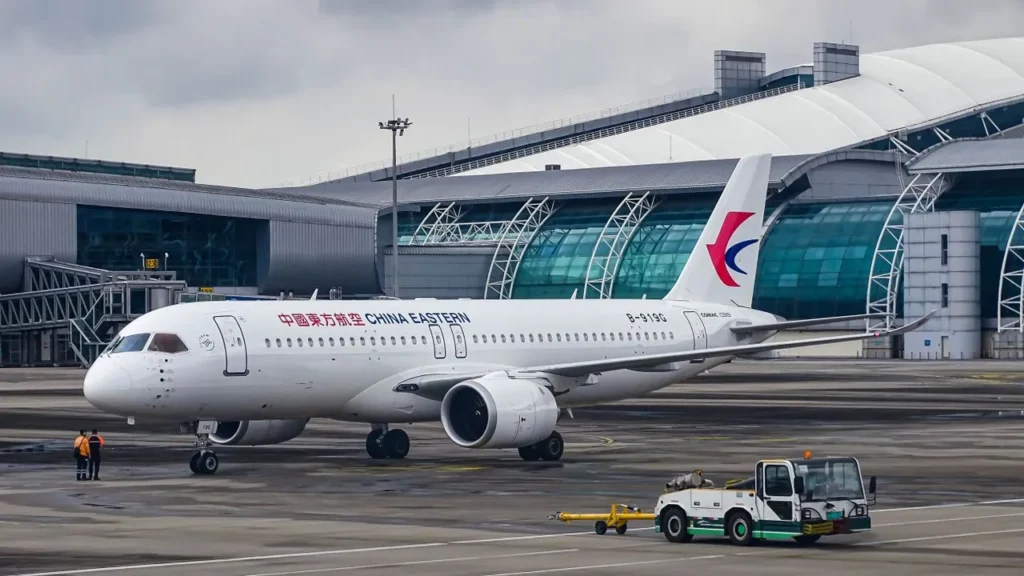
China Eastern Airlines (CEAir) highlighted its latest developments in digitalization and intelligent aviation technologies at the Fourth CATA Aviation Conference & Exhibition, held in Beijing in late September and organized by the China Air Transport Association (CATA).
The airline used the event to demonstrate how emerging technologies, including artificial intelligence (AI), robotics, connectivity solutions and intelligent equipment, are being integrated across different areas of its operations. The showcased technologies covered a broad range of applications, including flight operations support, passenger services, aircraft maintenance, air cargo and ground handling.
At its exhibition booth, China Eastern presented several practical applications of AI and intelligent technologies for civil aviation. Rather than focusing solely on conceptual demonstrations, the airline displayed physical prototypes, equipment models, multimedia presentations and interactive demonstrations to provide visitors with a closer look at how these technologies can be applied in real-world aviation environments.
One of the key highlights of China Eastern’s exhibition was an AI-powered flexible robotic arm system designed for in-flight meal arrangement.
The system uses adaptive end effectors that can identify, grasp and precisely position food items with different shapes, sizes and forms. This enables the automated arrangement of meals while reducing the need for repetitive manual handling.
The technology demonstrates how robotics and AI can be used to improve efficiency in airline catering operations, where large quantities of meals must be prepared and arranged according to standardized procedures. By introducing greater automation into the process, intelligent robotic systems could support more consistent operations while helping catering teams manage increasingly demanding workflows.
The flexible design of the robotic arm is particularly important because in-flight meals contain a wide variety of food items that differ in shape, texture and weight. The ability to adapt to these variations is essential for automation in catering environments.
China Eastern also showcased several intelligent robots designed to support passenger services at airports.
Among the exhibits were a service robot, a baggage-handling robot and a four-legged robot designed to provide transfer guidance. Developed by China Eastern and equipped with large-model capabilities, these robotic systems demonstrate the airline’s efforts to explore new applications for AI in the passenger journey.
Service robots can potentially assist passengers by providing information and guidance, while baggage-handling robots are intended to support the movement of luggage within airport environments. The four-legged robot, meanwhile, was presented as a solution for transfer guidance, potentially helping passengers navigate airport facilities and locate connecting flights or other services.
The integration of large-model technology into these systems is intended to improve their ability to interact with users and respond to different service requirements. As airports become increasingly digital, intelligent service technologies are expected to play a growing role in supporting passengers and improving operational efficiency.
Another major technology on display was China Eastern’s self-developed AI-powered network management platform.
The platform provides visibility into the real-time locations of the airline’s wide-body aircraft operating around the world. It can also display information about the satellites being used to provide in-flight internet connectivity.
The system reflects the growing importance of digital infrastructure in modern airline operations. With aircraft operating across multiple regions and relying on increasingly sophisticated communication networks, real-time monitoring and management of connectivity resources can provide airlines with greater visibility into their fleets and onboard communication services.
The platform also forms part of China Eastern’s broader focus on air-ground connectivity, an area that has become increasingly important as passengers expect reliable digital services throughout their journeys.
Air-ground connectivity has become a significant part of China Eastern’s digital transformation strategy. Since July 2026, the airline has offered complimentary in-flight Wi-Fi on flights operated by all of its wide-body aircraft.
According to the airline, this initiative places it among the first major airlines globally to make in-flight Wi-Fi a standard service available to all passengers on its wide-body fleet.
The expansion of onboard connectivity is intended to improve the passenger experience by allowing travelers to remain connected during flights. Depending on the available service and aircraft configuration, passengers can use onboard connectivity for communication, online services and other digital activities while traveling.
China Eastern’s focus on connectivity also demonstrates how airlines are increasingly treating onboard digital services as an integral part of the overall travel experience rather than an optional add-on.
The exhibition also featured several other digital and intelligent technologies aimed at improving the efficiency of airline ground operations and logistics.
Among the solutions presented were intelligent equipment for fresh-food cold-chain logistics, autonomous baggage tractors, modular hangars and digital terminals.
Cold-chain logistics is particularly important for transporting food and other temperature-sensitive products. Intelligent equipment can help improve monitoring, handling and transportation processes while supporting the maintenance of appropriate environmental conditions throughout the logistics chain.
Autonomous baggage tractors represent another area where automation could help improve airport ground operations. By reducing reliance on manual vehicle operation for certain repetitive transportation tasks, autonomous systems can support more efficient movement of baggage and equipment around airport facilities.
Source Link: https://www.businesswire.com/